


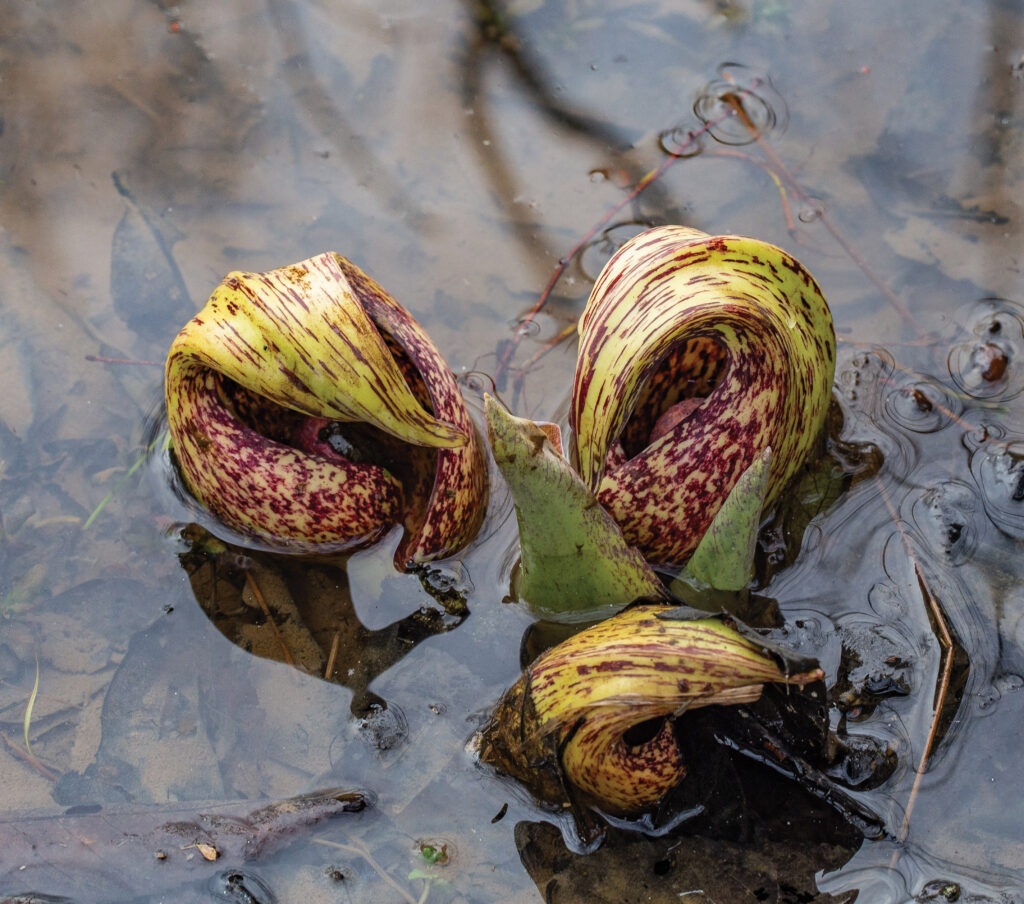
Skunk cabbage, a herald of spring at the tail end of winter, has a rare ability.
This story was originally published in the February/March 2026 issue of Wonderful West Virginia. To subscribe, visit wonderfulwv.com.
Written by Mikenna Pierotti
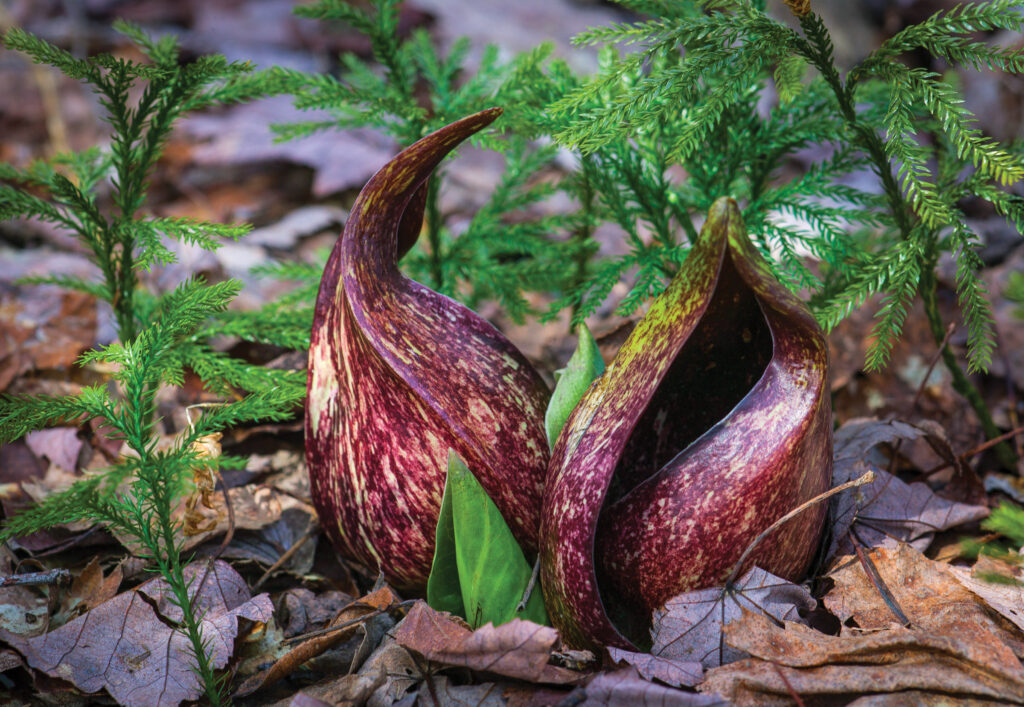
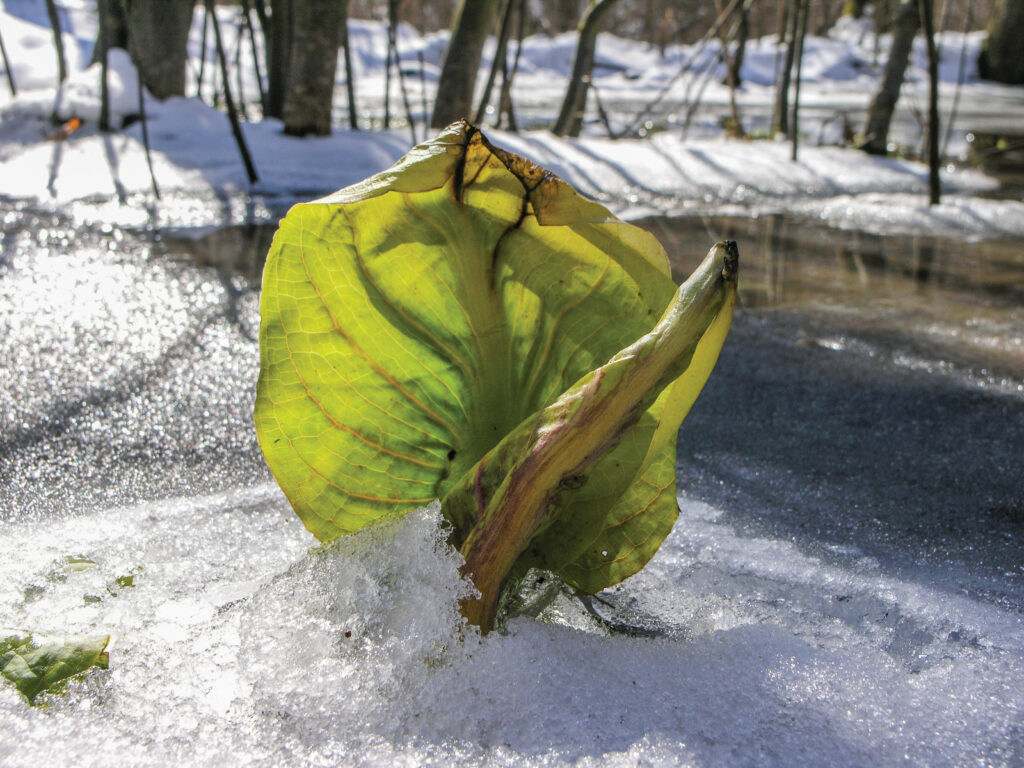
A chill fog hangs over Cranberry Glades in late winter. Fingerlike branches of bare trees reach overhead, frozen mud cracks into fractal patterns, and pockets of snow cling to mountainsides. But here and there, poking surprisingly colorful heads through ice and earth, is an unusual, hooded inhabitant: the skunk cabbage. With its mottled maroon outer covering, called a spathe, rising like a little lantern in the gloom, this sometimes-pungent upstart offers the promise of spring even when frost still slicks the ground.
For Katharine Gregg, professor emerita of biology and curator of the George B. Rossbach Herbarium at West Virginia Wesleyan College, such early signs of life are part familiar, part enchanting, and a little bit baffling. Over the course of her career, she has spent decades tracking plant phenology and wetland ecology across the region, from Cranberry Glades to Cranesville Swamp and from West Virginia into Maryland.
“They were in mucky soil on either side of the boardwalk,” she recalls of one memorable encounter with skunk cabbage at Cranberry Glades. From her vantage point, she wasn’t able to get down close enough to take a whiff. But, she says, it probably wouldn’t have been worth the effort. Despite the name, skunk cabbage only releases its olfactory-assaulting perfume during a narrow window. “It wasn’t flowering at the time, which probably means it wasn’t smelling then,” she says.
Nevertheless, skunk cabbage is a fascinating and important species all year long. Its sudden appearance, often long before tree buds swell, can feel almost miraculous. But its story involves biological boldness as much as seasonal predictability. The plant is one of nature’s great early risers, equipped with traits that allow it to thrive where few others dare.
In Defiance of the Snow
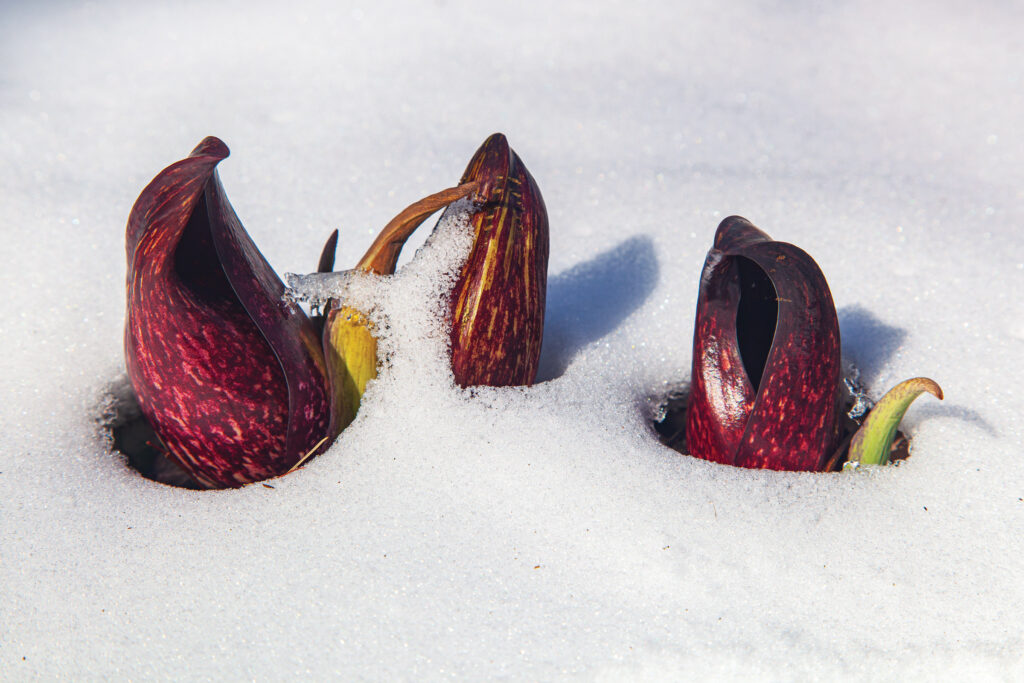
The eastern skunk cabbage (Symplocarpus foetidus) is more than just early. It is thermogenic, meaning it produces its own heat. This rare ability allows it to bloom while snow still covers the ground, sometimes melting ice in a small circle around its spathe.
“The spadix exhibits thermogenesis, or heat production, as the flowers open, and the heating lasts about 12 to 14 days,” Gregg says.
The spadix, the fleshy column of tiny flowers hidden within the hood-like spathe, can maintain an internal temperature far higher than the surrounding air during this period. “Temperatures inside the enclosing spathe can reach 68 degrees Fahrenheit,” she adds. This warmth allows skunk cabbage blossoms to persist even in freezing conditions, making it one of the earliest indicators of spring in wetlands and boggy woodlands.
Thermogenesis is not just rare. It is remarkable. Most plants rely entirely on environmental warmth to fuel flowering and leaf growth. Skunk cabbage, by contrast, taps stored carbohydrates and a specialized respiratory process to convert chemical energy directly into heat.
This adaptation gives skunk cabbage several advantages, including the ability to emerge before competitors and to disperse its distinctive odor more effectively, drawing pollinators in at a time when few other floral rewards are available.
Gregg says there may be even more at work. “Various proposed reasons for thermogenesis are to allow flowers to come up through snow, attract insects seeking a warm place, and provide warmth for maintenance of flowers and fruit development,” she says.
A Nose for Attraction
The name foetidus, Latin for “fetid,” gives it away. Skunk cabbage earns its common name from a strong odor that many people find unpleasant. To humans, it may be likened to cabbage gone bad, stinky mustard, or even skunk spray, Gregg says. For the insects that matter most to the plant, however, it is a dinner bell. “When it blooms, the smell and heat together attract early season pollinators,” she says.
The odor mimics carrion, drawing flies, gnats, beetles, and other insects that seek decaying material in late winter and early spring. Those insects do not just visit once. The scent and warmth reward them with a haven in cold weather and encourage them to wander among neighboring blossoms, carrying pollen from plant to plant.
Even honeybees, rare visitors to such early blooms, may use the warm interior as a place to rest or heat up on cold days.
Wet Places, Rich Lives
Skunk cabbage belongs to water. It thrives in swamps, glades, wet meadows, floodplains, and bogs and along stream edges where the ground stays damp. It is an obligate wetland species, meaning it cannot survive long in dry conditions.
In West Virginia’s diverse landscapes, from the highlands of the Allegheny Plateau to the Appalachian Ridge and Valley, these wet places, often overlooked, are ecological hotspots. They filter water, slow floodwaters, and provide habitat for rare salamanders, mosses, and a host of other flora and fauna. Skunk cabbage is often one of the first native plants to make these places visible each year.
According to herbarium records, Donna Ford-Werntz, service professor and director of the WVU Herbarium, the largest facility of its kind in the state, says skunk cabbage “is documented by 45 collections from 23 West Virginia counties, mostly in the eastern part of the state.”
But its range extends well beyond West Virginia. “It also occurs in the northeastern United States, from Minnesota and Iowa to Maine, and south through North Carolina, as well as southeastern Canada, from Ontario and Quebec to New Brunswick and Nova Scotia,” Ford-Werntz says.
A Living, Growing System
For those hoping to experience skunk cabbage at its most pungent, visit a swampy woodland ecosystem in early spring, when flowering peaks.
“It blooms mostly in March and April, with fruit from July through September,” Ford-Werntz says.
“The tiny flowers lack petals but have four knobby sepals at the base of either four stamens in male flowers or one pistil with one ovary for female flowers,” Gregg adds. The numerous flowers on the stalk-like spadix, she says, are surrounded by the fleshy, hood-like spathe.
“The reproductive structure, a spadix surrounded by a spathe bract, is similar to Jack-in-the-pulpit and other members of the plant family Araceae, or aroids,” Ford-Werntz says. “However, in this species, the flower stalk is partly underground and often appears below or through melting snow.”
By midsummer, the plant’s fruits dominate. After pollination, the spadix swells into a squat, knobby fruit head as the spathe withers away. The stalk elongates, and the developing fruit head often ends up low to the ground, sometimes reclining along the wetland floor. About two inches across, it holds many berry-like fruits in a bumpy, blocky pattern, with each fruit typically containing a single seed. As it ripens, the fruit head darkens from greenish tones to maroon and eventually deep brown or black, which can make it easy to miss against rich wetland soil and decaying leaves.
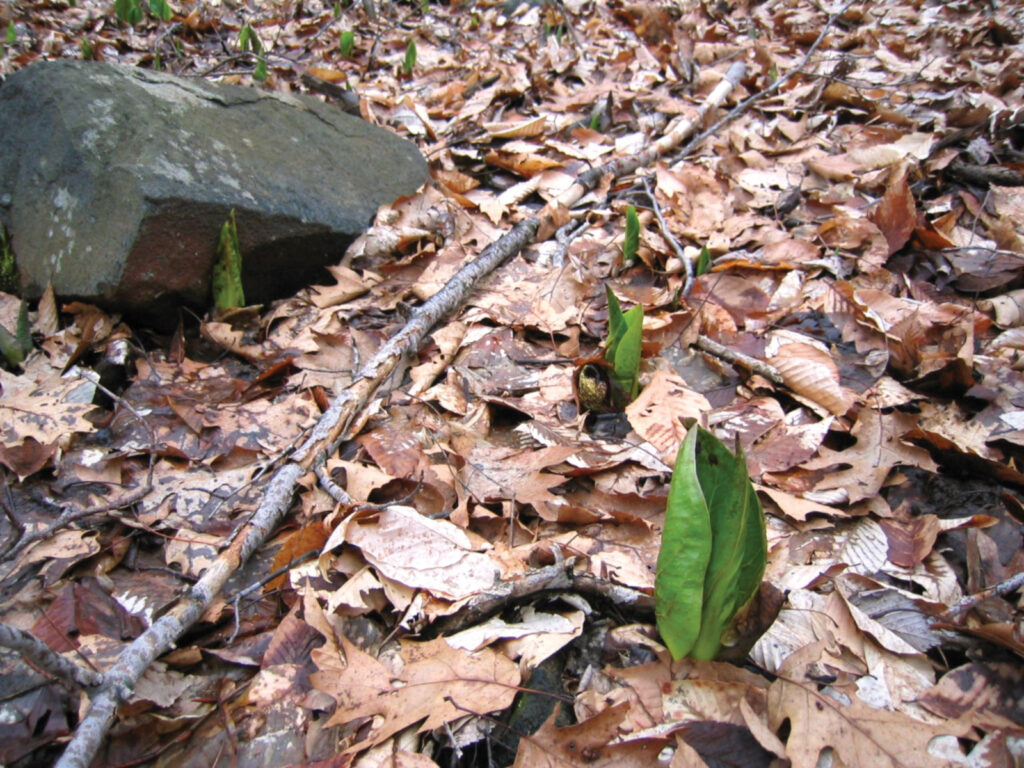
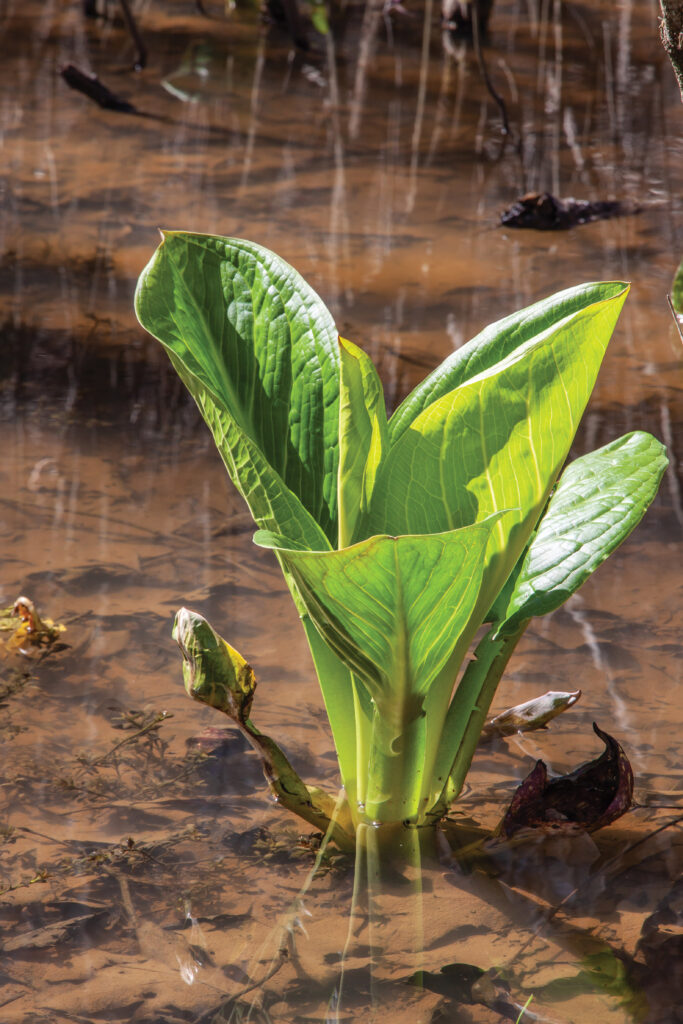
As the early blossoms fade, skunk cabbage also produces large, bright green leaves that resemble cabbage, hence the second half of its common name. These leaves persist through spring and early summer, capturing sunlight and shading the wet soil beneath.
Ecologically, that matters. In wetland systems, rapid water movement and shifting sediments can damage plant roots and delicate microhabitats. Broad-leaved spring plants like skunk cabbage help stabilize those conditions.
The plant’s longevity is notable, too. Skunk cabbage can live for decades, gradually pulling itself deeper into the soil through contractile roots. These specialized roots slowly shorten over time, drawing the plant downward and helping protect it from freezing, shifting sediments and the constant push and pull of wetland conditions. Left undisturbed, individual plants may persist for generations.
Wild Neighbors and Human Medicines
While most animals avoid this odiferous plant, some decidedly do not.
“Bears eat it,” Gregg says. “My husband and I have seen the leftovers strewn along the boardwalk at Cranberry Glades. A bear apparently strolled along, pulling up and eating plant after plant, leaving a few remains along with its scat.”
Other herbivores, including snails, slugs, and even snapping turtles, in some regions, may also feed on skunk cabbage, although its calcium oxalate content makes raw leaves irritating to many mouths.
Humans, too, have a long, if cautious, relationship with the plant. Native American cultures may have used parts of skunk cabbage medicinally, Gregg says, particularly dried roots used as antispasmodics, expectorants, and treatments for respiratory complaints. From around 1820 to 1882, extracts known as dracontium were sold in pharmacies for coughs, asthma, and other ailments.
But caution is key. The same compounds that made skunk cabbage useful in small doses can be irritating or toxic if consumed raw. Foragers generally avoid eating it unless they know exactly what they are doing.
A Symbol of Resilience
Given its pungent reputation and unusual biology, skunk cabbage might seem an odd ambassador for West Virginia’s wild spaces. But that is precisely the point. It thrives where water flows slowly, where life softens uncertainly into spring, and where fragile ecosystems support an array of vibrant life.
In Appalachia’s swamps and wet woods, places shaped by water, time, and grit, skunk cabbage is an early signal that life will return. Its heat melts ice, its smell draws life, and its leaves shelter the soil around it.
But it is easy to miss. Even Gregg says she does not recall seeing skunk cabbage in large quantities outside Cranberry Glades. Still, it persists, sometimes tucked away, on the margins, often outliving many louder species.
“The Flora of West Virginia states that it is common and probably in every county,” Gregg notes.
This little winter wonder is a reminder that resilience does not always make a big entrance. Often, it burns quietly in the dark, waiting for its moment to bloom.