


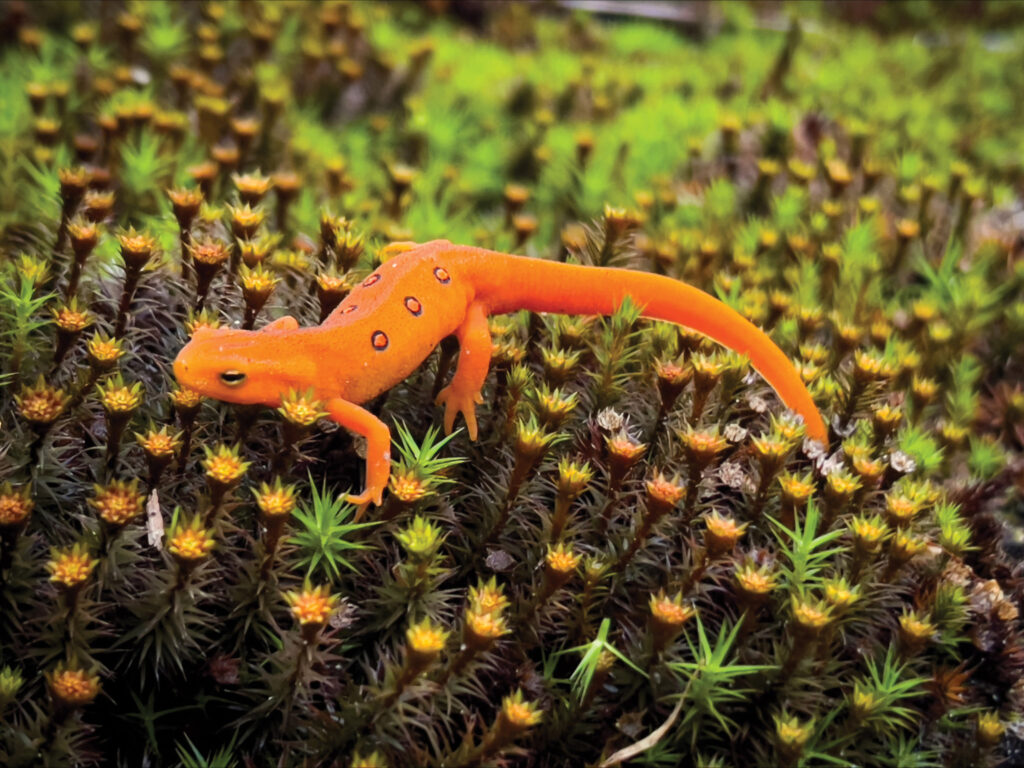
Keep your eyes peeled for this popular semiaquatic amphibian.
This story was originally published in the April/May 2026 issue of Wonderful West Virginia.
Subscribe here.
Written by Devin Lacy
Photograph by Joe Hildreth
Back in January, the West Virginia Division of Natural Resources released its latest citizen science project—this one focused on the eastern newt, also known as the red-spotted newt.
Disease is one of the most common threats amphibians face, including a newly emerging strain of chytrid fungus, B. salamandrivorans, commonly called Bsal, that has been discovered in Europe and Asia. Given how easily it spreads, the WVDNR is preparing for a likely future appearance of Bsal in the state by studying eastern newt populations in West Virginia to get an idea of abundance and distribution, and you can help.
While you’re out exploring the Mountain State’s forests and wetlands, keep an eye on where you step. If you spot an eastern newt in one of its three life stages—the fully aquatic and gilled larvae, the orange-hued and spotted red eft that scampers on land, and the once-again aquatic adult with a brownish-green body and those distinctive red spots—take note of where you spotted it and when, and snap a few photos if you can. Then, submit your findings to the WVDNR through its online survey at WVdnr.gov/eastern-newt-survey.
In the meantime, you can help prevent the spread of many diseases affecting our aquatic wildlife by washing shoes, gear, and even your boat between trips out to new locations.
Disinfect gear with hot water—approximately 140°—or a 10% bleach solution for 10 minutes. Ensure everything is completely dry before reuse. Scrub all surfaces of your boat with a stiff brush and high-pressure water, using a 10% bleach solution or a multi-surface disinfectant spray, particularly on rubber components.