


A study of West Virginia’s rabbits and hares is revealing vital clues about the future of our mountain ecosystems.
This story was originally published in the October 2025 issue of Wonderful West Virginia. To subscribe, visit wonderfulwv.com.
Written by Mikenna Pierotti
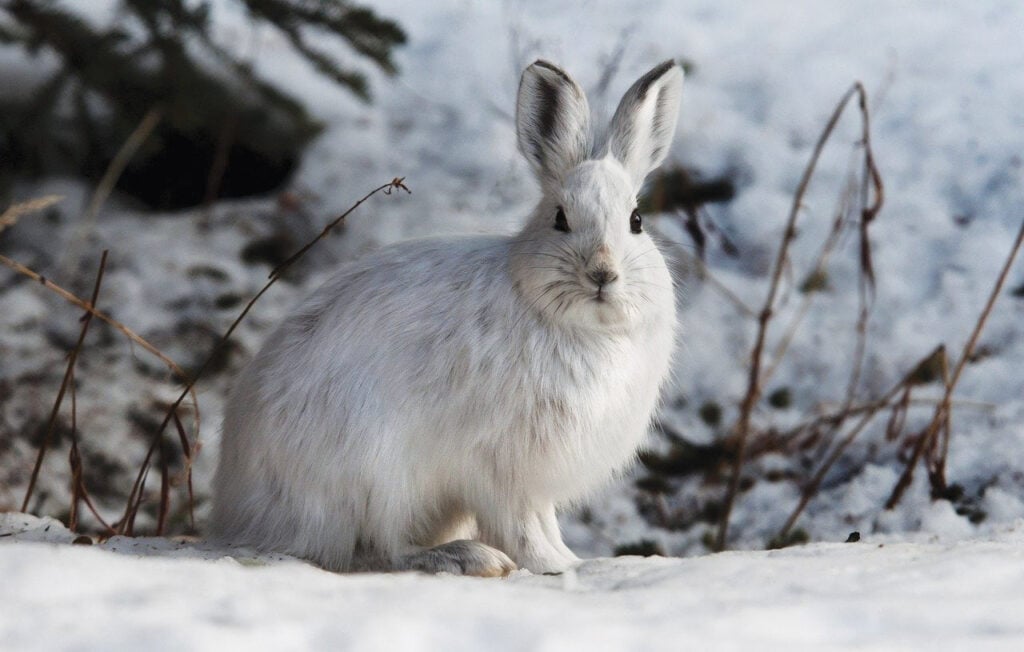
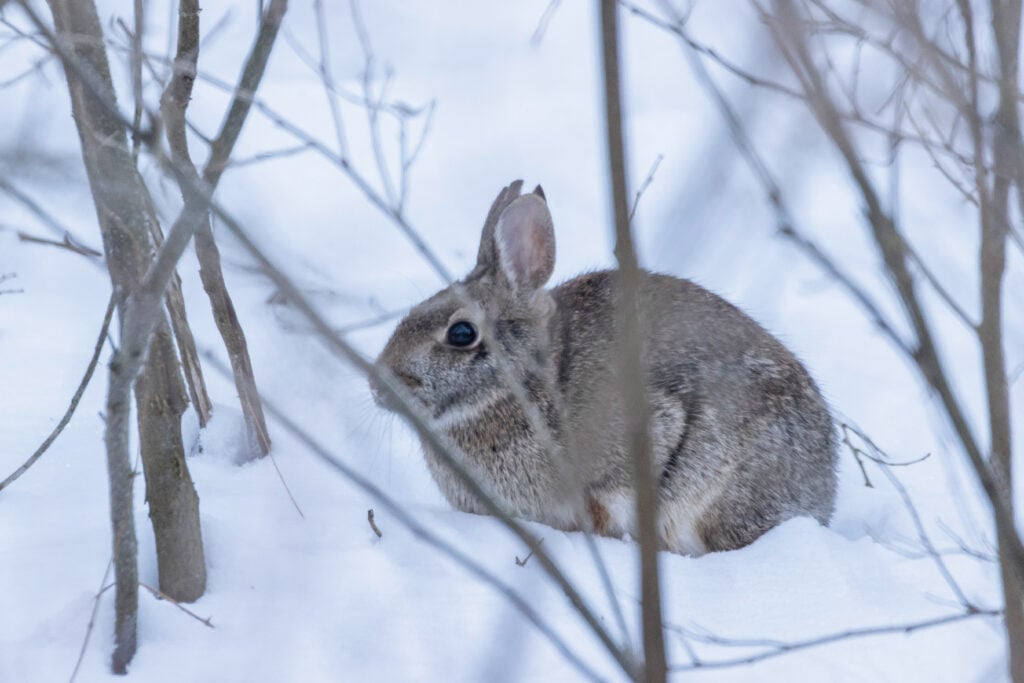
It’s a crisp February morning in the highlands of Randolph County. Frosted needles shimmer in red spruce stands, bark and bare branches creak and groan in the wind, and an elusive snowshoe hare pauses cautiously in fresh powder—nearly invisible in its perfectly white coat, save for twitching dark eyes and the flare of a pink nose. Nearby, hidden in dense brush, its rabbit cousin, the Appalachian cottontail, keeps her own secrets as she quietly navigates life in West Virginia’s rugged mountains, blending into muddy paths and leaf-strewn gaps between snow piles.
“Rabbits and hares are part of the food web,” says Holly Morris, West Virginia Division of Natural Resources (WVDNR) furbearer and small game project leader. As key indicators of forest health and habitat quality, Morris sees them as more than iconic species—they’re keystone creatures.

To better understand and protect these small but crucial mammals, the WVDNR, in collaboration with West Virginia University, launched a four-year research project in 2023 to study the population dynamics, distribution, and genetics of snowshoe hares and Appalachian cottontails across the Mountain State. It’s one of the most comprehensive studies of its kind ever undertaken in the region.
Highlanders, Roamers, and Opportunists
In West Virginia, rabbits and hares carve out unique lives shaped by the niches they call home.
“These populations are stable and provide recreational hunting opportunities—and they provide food sources for avian predators like owls and hawks as well as for mammalian predators such as foxes, bobcats, and coyotes,” says Morris. “However, each of these species has specific habitat preferences.”
The snowshoe hare, Lepus americanus, famous for dramatic seasonal shifts in fur color—brown in summer and white in winter—thrives at high elevations, especially in red spruce forests in Pocahontas, Randolph, and Tucker counties. Forests that are 10 to 20 years old provide the thick thermal and predator cover these animals need to survive harsh conditions.

Appalachian cottontails, Sylvilagus obscurus, prefer brushier landscapes above 2,500 feet—northern hardwood forests thick with blueberry and heath-like vegetation. Meanwhile, eastern cottontails, Sylvilagus floridanus, the most abundant rabbit species in the state, are generalists, equally at home on farmland edges, abandoned fields, and even suburban lawns.
Telling the two cottontail species apart is tricky. The Appalachian cottontail is slightly smaller, with shorter ears, brownish fur, and often a distinctive black spot between the ears—but typically no white forehead patch like its eastern cousin. Because their external traits are so similar, skull morphology is sometimes used, but genetic testing is the only reliable method for proper identification. This level of precision has become increasingly important as ranges overlap and climate pressures shift habitats.
Despite their differences in habitat, all three species graze on herbaceous plants and grasses in warmer months, switching to twigs and bark in the fall and winter.
Their role in the ecosystem is just as critical. Populations of rabbits and hares cycle every eight to 10 years, helping stabilize predator numbers and even reducing pressure on other prey species. Their grazing and burrowing also shape the landscape, maintaining open spaces in dense forests where biodiversity can flourish. It’s a quiet but essential rhythm in the life of the woods. Without them, entire food chains could shift, with ripple effects across plant and animal communities.
A Hare-y Horizon
Despite their adaptability, snowshoe hares and Appalachian cottontails face growing threats—from habitat loss to climate shifts and disease.
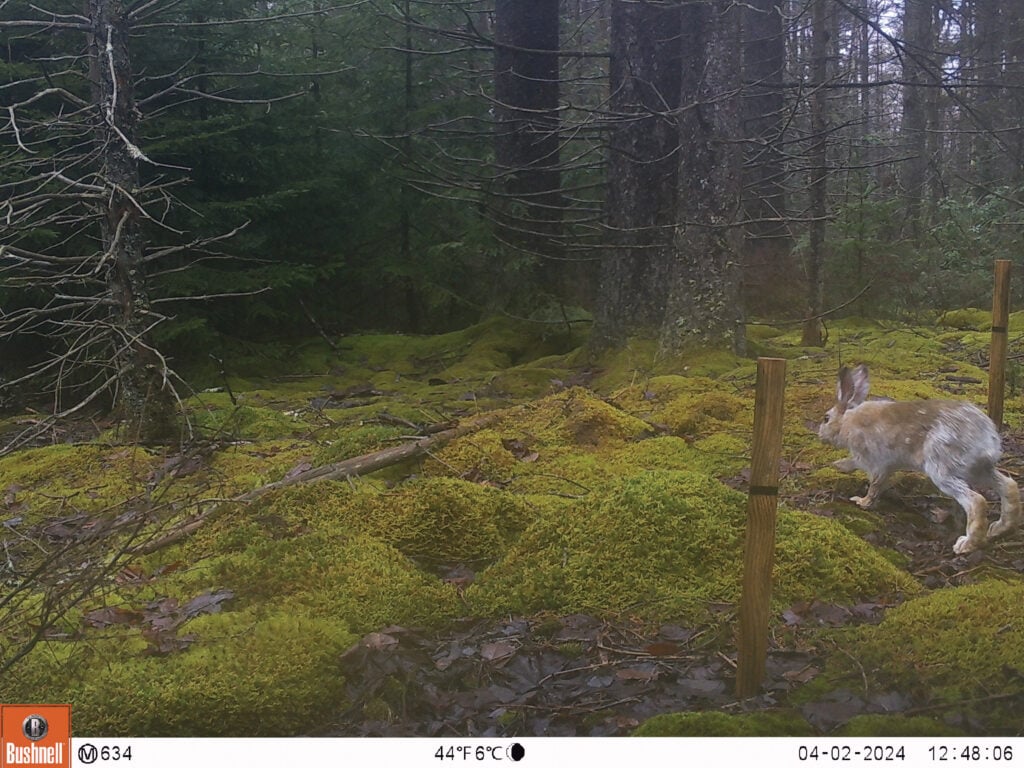
Snowshoe hares occupy the southernmost edge of their North American range in West Virginia, making them especially vulnerable to environmental change. One concern: mismatched camouflage. As winters become milder and snowfall less predictable, some hares may grow or retain their white coats out of season—standing out starkly against brown ground and increasing their vulnerability to predators.
According to Mack Frantz, a zoologist with DNR’s Natural Heritage Program for Wildlife Diversity, the last extensive mapping of snowshoe hare distribution took place in 1967. Since then, land use changes and climate fluctuations have likely altered their population and range.

Appalachian cottontails, meanwhile, are becoming more isolated as young forests mature. That isolation leaves them increasingly at risk—not only from climate events but from competition with eastern cottontails and potential hybridization.
Another looming threat is rabbit hemorrhagic disease virus serotype 2 (RHDV-2). First detected in U.S. domestic rabbits in 2018, it spread to wild populations by 2020. The virus is hardy, spreading through contact with infected rabbits or contaminated surfaces, and can cause sudden death with little warning. Symptoms include lethargy, fever, and internal bleeding.
Although the disease is not yet present in West Virginia, biologists are monitoring closely. “Increased disease surveillance efforts may allow for early detection and implementation of management strategies for RHDV-2,” Frantz says. So far, early testing indicates that hares may be more resistant to the disease than cottontails—but without monitoring, no one can know for sure.
Tracking Trails and Cottontails
To proactively address these risks, WVU biologists Amy Welsh and Chris Rota teamed up with Morris, Frantz, and doctoral student Madison Miller to launch an ambitious, non-invasive field study. Using genetic analysis and trail cameras, the team is piecing together a clearer picture of lagomorph life in the highlands.
“In coordination with Game Services, we are collaborating with West Virginia University to address several objectives as part of a Ph.D. graduate student research project,” Frantz says. “Objectives include a RHDV-2 risk assessment, population density estimates and influence of habitat, and assessment of population structure and genetic diversity within these populations.”
Fieldwork began in 2023 and continued through 2024. Researchers visited 115 sites across the state, returning six times throughout the year to collect fecal pellets. These droppings are rich in genetic data. “Fecal pellets are genetically analyzed to tell species and individuals apart so we can determine local densities using spatially explicit capture–recapture models,” Frantz says. “Over 332 samples have been analyzed down to species, including eastern and Appalachian cottontails and hares.”
Further analysis will determine whether hybridization is occurring between Appalachian and eastern cottontails—something only recently confirmed in neighboring North Carolina. Testing also helps monitor for disease markers.
Camera trap arrays were deployed along several transects in 2023 and 2024, with 39 cameras per site capturing more than 1.5 million images over three sampling seasons. These images, combined with ground surveys, are being used to assess vegetation structure, canopy cover, and seasonal conditions—painting a detailed picture of where and why certain species thrive. Researchers will also compare “leaf-on” and “leaf-off” conditions to determine how seasonal changes influence habitat use.
Bounding into the Future
This research is already yielding powerful insights—not just for scientists but for hunters, land managers, and anyone who values the wild heart of the Mountain State.
“In addition to small game being important to hunters, snowshoe hare and Appalachian cottontails are Species of Greatest Conservation Need in the West Virginia State Wildlife Action Plan and tracked as species of regional importance in the Northeast,” Frantz says. Meaning, these animals are valuable to everyone: To those who hunt. To those who manage the land. And to those working to preserve the rich, interwoven fabric of Appalachian ecosystems. Understanding their habits, distribution, and genetic health is key not only to their survival but to maintaining the balance of the landscapes they shape.
“The information we gather will help wildlife managers justify the need for development and maintenance of young forest habitats,” Morris says. That, in turn, benefits a wide array of game and nongame species. For hunters, who enjoy a long rabbit and hare season from November through February, the study could help preserve—and even enhance—future opportunities. It’s a rare case where science, tradition, and conservation all point in the same direction.
A Fluffy Barometer
This isn’t the first time West Virginia’s rabbits and hares have gotten a helping hand. Snowshoe conservation goes back decades—starting around 1949, when native hares were joined by transplants from Wisconsin to strengthen local populations. Local hunting clubs also worked to keep cottontail numbers healthy in the 1920s. In the 1960s, mapping projects laid down a rough but important foundation, giving later biologists a snapshot of where these animals once roamed.
Today’s study builds on that legacy with the power of modern data and collaboration.
“Some sites strictly had hares, some only Appalachian cottontails, some Appalachian and eastern cottontails, and some had all three species; we plan to determine the influence of habitat in leaf-on and leaf-off conditions for these areas,” Frantz says. “Ground cover, species composition, canopy cover, basal area, and understory density are some of the many habitat variables that were documented to be assessed.”
The team also hopes to answer broader ecological questions—like whether changes in climate are affecting the snowshoe hare’s seasonal camouflage, or whether high-elevation hares in West Virginia experience fewer predator threats than their counterparts elsewhere, and perhaps even whether preserving these elusive species can ripple outward—protecting the forests, wildlife, and culture that have shaped West Virginia for generations.
Final results are expected by December 2026. When complete, the study will offer an invaluable roadmap for conservation—grounded in science, shaped by tradition, and rooted in a deep respect for the animals that make our wild places whole.