 By
By 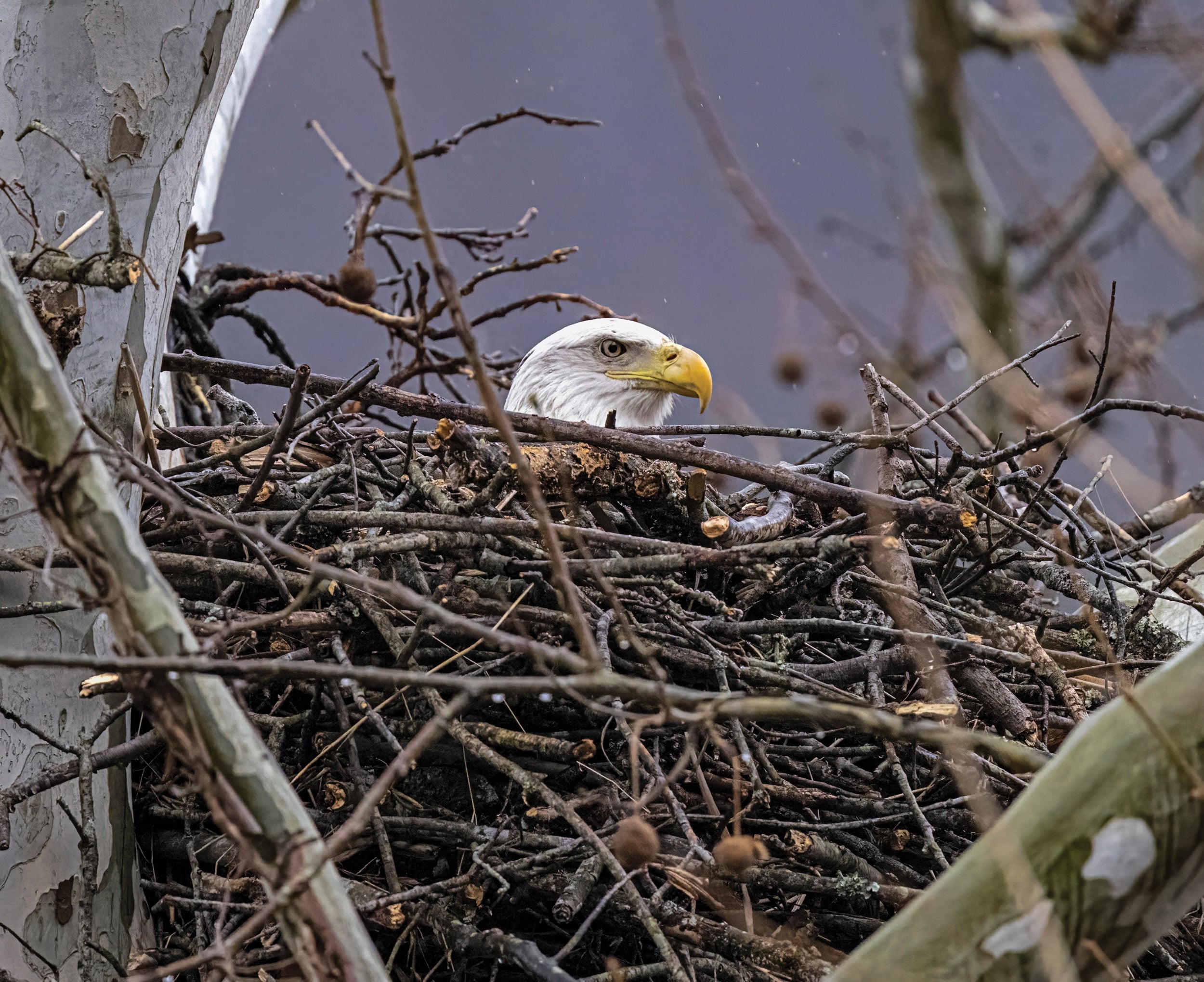
The recovery and restoration of the bald eagle in West Virginia.
This story was originally published in the June / July 2026 issue of Wonderful West Virginia.
Subscribe here.
Written by Katie Fallon
Featured Image Photographed by Gary Wendell
Despite Benjamin Franklin’s insistence that it was a bird “of bad moral character,” in 1782, Congress adopted the bald eagle as the emblem of the new United States. Since then, in addition to gracing the Great Seal of the United States, the bald eagle’s image has appeared as a logo for everything from professional sports teams and airplanes to clothing, beer, and motorcycles.
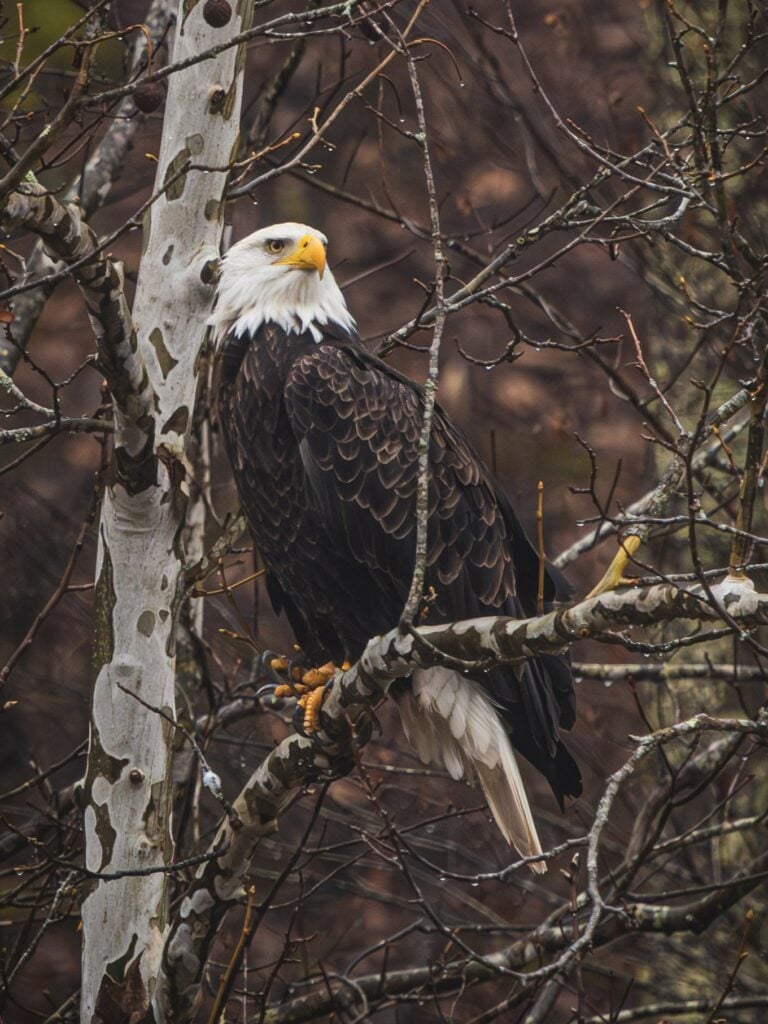
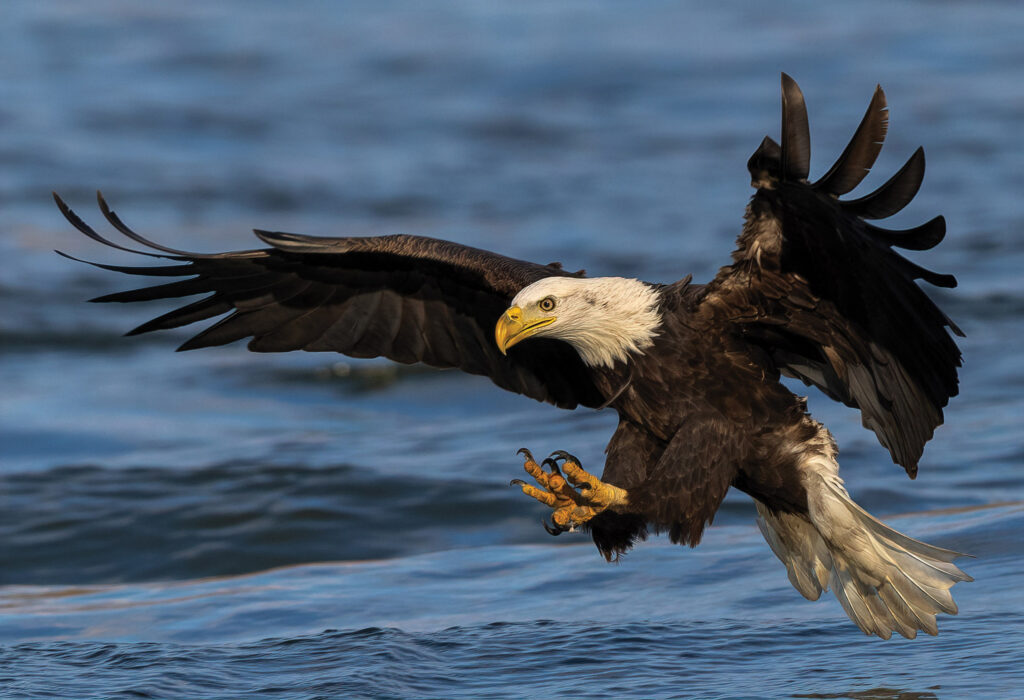
Our national emblem is the only eagle species with a range exclusively in North America, stretching from northern Mexico in the south to Alaska in the north. It’s an impressive bird, and adults are virtually unmistakable, with their white head and tail feathers, dark brown body and wing feathers, and yellow beaks, legs, and feet.
The bald eagle sports a wingspan of 6 to 8 feet and weighs up to 13 pounds. It’s not the largest or the fastest bird in the U.S., but when it comes to power and ability, it’s rivaled only by the golden eagle, which is also found in parts of Europe, Asia, and Africa. Both species have been deemed our country’s “biggest,” and both claims are generally true: The bald eagle usually has a wider wingspan, and the golden eagle is typically heavier.
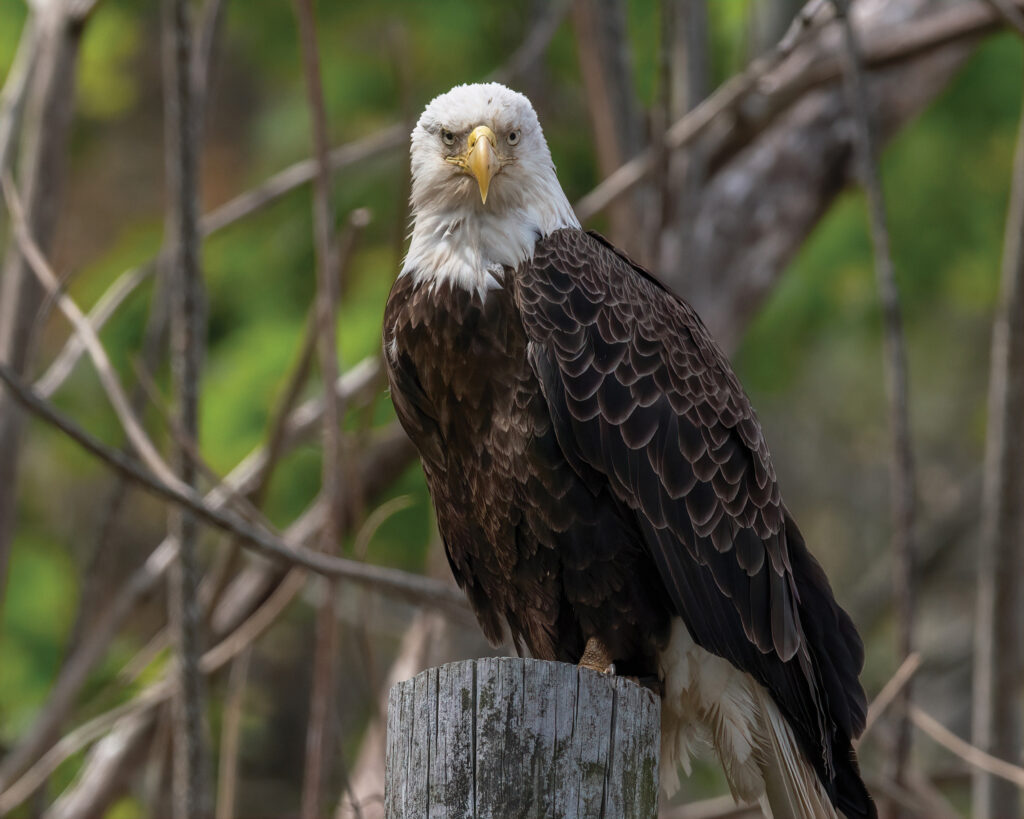
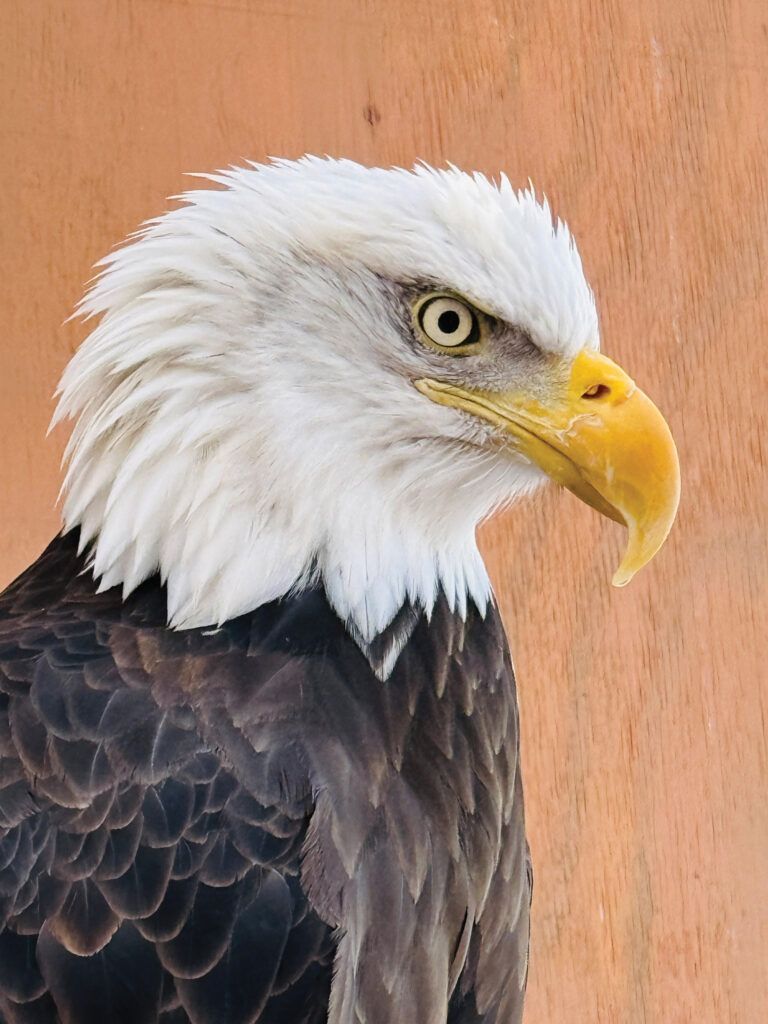
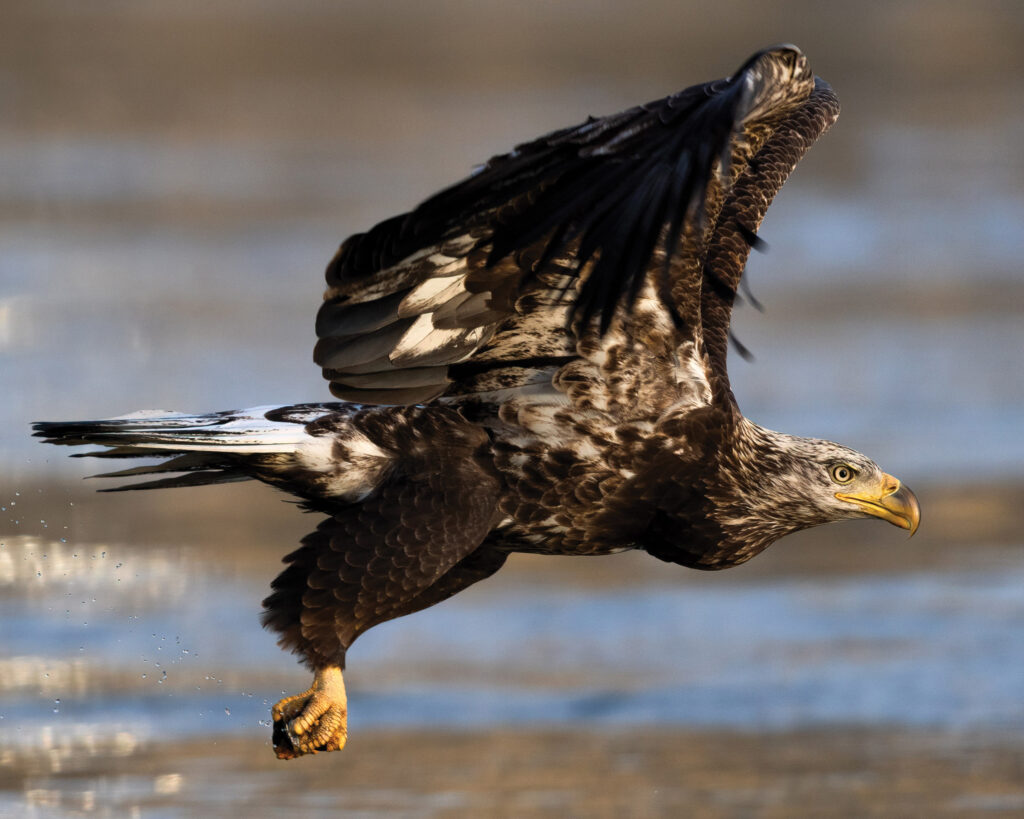
Like other raptorial birds, the bald eagle uses powerful talons, a strong hooked beak, and excellent eyesight to find and capture prey. They eat mostly fish, but these opportunistic hunters will also eat mammals, waterfowl and other birds, and reptiles. They’ll also scavenge at garbage dumps, on roadkill, and on the remains of deer and elk killed by humans or other large predators. Ospreys and herons tend to be more successful fishers, but bald eagles don’t hesitate to steal food from them. This fish-thievery may have contributed to Benjamin Franklin’s less-than-flattering opinion about the bald eagle’s moral character.
Perhaps Franklin’s perspective about bald eagles would be different if he knew about the strong bond formed within eagle pairs. Known to mate for life, a male and female bald eagle may return to the same nest site for decades. Both members of a pair construct the nest, which consists mostly of sticks along with grass, moss, and feathers. Nests can be huge and messy, and they’re often built in large trees alongside bodies of water. According to Birds of the World, the female eagle lays between one and three eggs, and she does most of the incubation herself, while her mate delivers food to her. The eggs hatch after about 35 days. Once hatched, the eaglets remain in the nest for two to three months before fledging, and they continue to depend on their parents for food for another six weeks or more.
Bald eagles do not attain their signature look until about 5 years of age. Despite the stories circulating on social media, bald eagles do not pull out their feathers, beaks, or talons when they turn 40 years old. In fact, according to the federal Bird Banding Lab, the longevity record for a wild bald eagle is 38 years.
Recovery and Restoration
The bald eagle is one of our nation’s most dramatic conservation success stories. Over the past 250 years, it has experienced a roller-coaster of ups and downs.
Little more than a century after the species was chosen as the emblem of the young USA, the state of Alaska began offering bounties on hunter-killed bald eagles because the birds were believed to compete with humans for fish. The bounties ended in 1940 with the passage of the federal Bald and Golden Eagle Protection Act—but the species continued to decline because of the effects of the pesticide DDT, which weakened eagle eggs’ shells and prevented the birds from reproducing successfully.
In 1967, bald eagles were granted “endangered” status. Fortunately, the widespread use of DDT was banned in the U.S. in 1972, and with protection efforts in place and a new national awareness about environmental issues, populations began to recover. The species was downlisted to “threatened” in 1995 and, in 2007, it was delisted altogether—an extraordinary success story, and one we in West Virginia are benefiting from.
“While it’s unknown whether bald eagles historically nested in West Virginia, the first confirmed nest was discovered in 1981 in Hardy County, along the South Branch of the Potomac River,” says West Virginia State Ornithologist Richard Bailey. A second nest in the same county was observed in 1989, and since then, the breeding population of bald eagles in our state has continued to grow. “Over the remainder of the 20th century, the species expanded its breeding occurrence to 10 nests in five counties in the Eastern Panhandle,” Bailey says. “From 2000 to the present, the continued population increase has been remarkable: As of 2026, 186 nests have been documented in all major watersheds of the state, representing an increase of 1,760%!” The South Branch of the Potomac River may be the best place to view bald eagles in West Virginia, especially near the section of the river known as The Trough. The Trough Canyon excursion on the Potomac Eagle Scenic Railroad, based in Romney, is a great way to spot them.
In addition to the Potomac watersheds, bald eagles can also be observed along the Bluestone, Gauley, Greenbrier, Monongahela, Kanawha, New, and Ohio rivers as well as at Cheat, Sutton, Stonewall Jackson, Tygart, and other lakes across the state. Eagle nesting season in West Virginia begins as early as December, and nests may be active until early July.
Master Naturalist Jay Smith, who volunteers with Oglebay Good Zoo’s Raptor Rehabilitation program in Wheeling, has been documenting eagle nests in West Virginia for more than 20 years, and he believes that this may be a good year for bald eagle nest success. He reminds enthusiasts that bald eagles can be sensitive to activity near their nests and to stay at least 100 meters from any active bald eagle nest, the legal minimum distance mandated by the U.S. Fish & Wildlife Service for hikers, boaters, hunters, and birdwatchers.
Humans Helping Eagles
Despite increasing numbers in West Virginia and throughout Appalachia, bald eagles in the wild face several significant threats. Federal and state laws prohibit intentional shooting, trapping, and harassment of eagles, but violations still occur. Additionally, bald eagles, along with other avian scavengers, can become sick after ingesting small fragments of lead left in white-tailed deer gut piles or from eating fish that have swallowed lead sinkers.
Several diseases pose threats to bald eagles, too, including highly pathogenic avian influenza, a contagious disease spread by wild and domestic birds, as well as West Nile virus and aspergillosis. Bald eagles also sometimes strike power lines and windmills while soaring, become entangled in fishing line, and are hit by vehicles.
“To address these threats,” says Bailey, “the West Virginia Division of Natural Resources (WVDNR) works closely with agency partners such as the U.S. Fish and Wildlife Service, nonprofit partners such as the Avian Conservation Center of Appalachia (ACCA) and Three Rivers Avian Center (TRAC), and the renewable energy industry.” Possibly the most important partners are state residents, he says, who can report eagle nests and any injured or sick birds they encounter to the WVDNR. They can also choose to use non-lead ammunition when they hunt.
Bald eagles and other raptor species in need of assistance can be admitted for rehabilitation to the ACCA in Morgantown, TRAC in Hinton in the southern part of the state, and Oglebay Good Zoo’s raptor rehabilitation program in the Northern Panhandle. These licensed facilities work with the WVDNR and other state and federal agencies to restore native birds to the wild.
They also take permanent care of some bald eagles that would no longer be able to care for themselves if they were released—and that creates an opportunity to view these large, dramatic birds up close. “Growing up in the 1960s, I never thought that I would see a bald eagle, let alone work with them and have our bald eagle Regis as a permanent ambassador,” says TRAC Executive Director Wendy Perrone.
The bald eagle holds an important place in the hearts and minds of Americans, both as a symbol of freedom and strength and as a conservation success story. “Living here in West Virginia now with bald eagles nesting nearby is such a change in their status,” Perrone says. “It is a strong case for how important it is for everyone to be involved in protecting these special birds and the ecosystems that sustain them.”
Meet Bald Eagles in Person
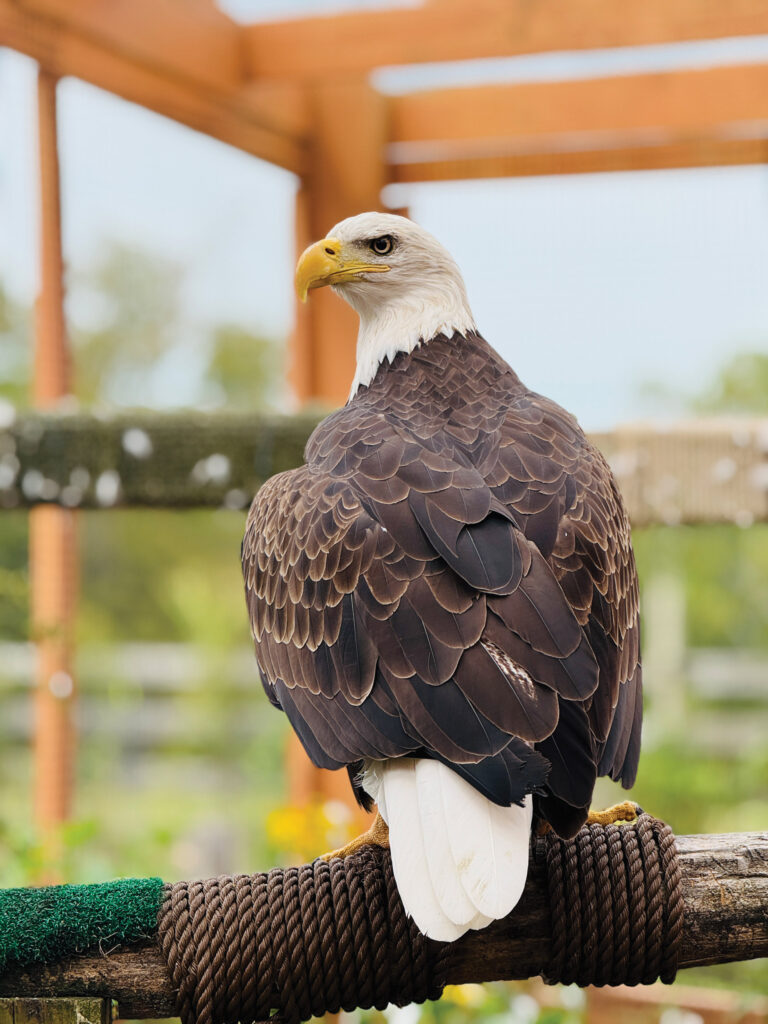
Members of the public can see non-releasable bald eagles living under human care at various rehabilitation facilities in the state.
Potomac—”Mac,” to his friends—and Seneca enjoy visitors to the Avian Conservation Center of Appalachia in Morgantown on Friday afternoons, March through October, 1–6 p.m.
Meet Amelia at the Oglebay Good Zoo in Wheeling daily, 10 a.m.–4 p.m.
Regis may be seen at the Three Rivers Avian Center in Hinton during free public tours on the first Saturday of the month, May to October, 1–5 p.m.
You will also find bald eagles who cannot be released into the wild at the West Virginia Wildlife Center in French Creek year ’round—check current hours before you go.
Courtesy of Katie Fallon

 By
By