 By
By 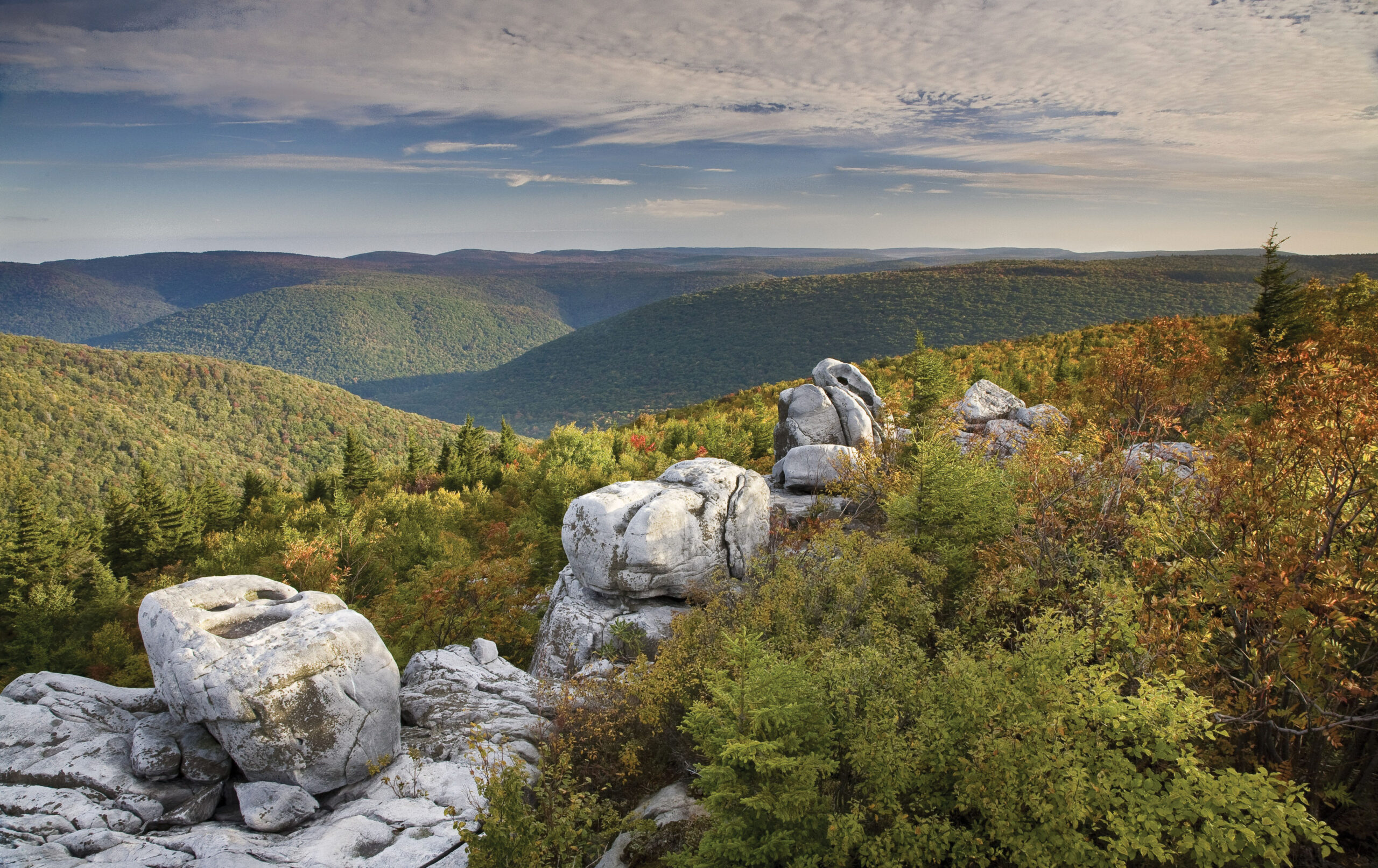
Mount Porte Crayon is an ecologically diverse peak with a historically famous name.
This story was originally published in the August 2025 issue of Wonderful West Virginia. To subscribe, visit wonderfulwv.com.
Written by Stan Bumgardner
Photographed by Kent Mason
Yew, Droop, Cheat, Ice? They’re not band names, nor Quentin Tarantino characters. How about the underworldish Devil’s Backbone? Bear Garden and Big Schloss? Perhaps they’re old vaudeville acts on the Wheeling Jamboree? Given your love of this beloved nature magazine, you likely solved the riddle on the initial hint or two: They’re all unique mountain names in West Virginia.
But none of them is as distinct as Mount Porte Crayon, which tops off at 4,770 feet, our state’s sixth tallest, in northeastern Randolph County. It’s the highest point in the Roaring Plains West Wilderness, a high, mostly level—at least for West Virginia—windswept plateau that includes Dolly Sods Wilderness.
So how did a mountain region with such deep German and Scots–Irish roots get such a Parisian name?
An Artistic Namesake
Porte Crayon was the pen name of David Hunter Strother (1816–1888), a Martinsburg-born artist and journalist of Scots–Irish and German ancestry. Trained in New York and Europe, Strother was a master of woodblock printmaking, an intricately detailed art form that requires artists to cut reverse images into wooden blocks, coat the raised areas with ink, and delicately but firmly press the blocks onto paper. This meticulous process requires artistic carving skills, the ability to imagine everything you see backwards, and the patience of Job.
Strother was one of the nation’s top image journalists, sketching real-time moments such as John Brown’s trial and hanging in Charles Town (1859), the conflagration at the Harpers Ferry Armory and Arsenal at the beginning of the Civil War (1861), and strategic topographic maps for Union commanders and various military actions during the war.
By the early 1850s, though, he hadn’t yet received much national acclaim. Already 35, he must have begun to feel like his dreams of being a great artist were nothing but that—dreams.
Then, in 1851, his fortunes changed. Maryland lawyer and politician John Pendleton Kennedy decided to revise his nearly 20-year-old popular novel Swallow Barn: A Sojourn in the Old Dominion, set near Martinsburg, and he called upon Strother to produce 20 illustrations for the new edition. The book was a hit, and Strother’s portraits provided us with some of the finest drawings of everyday people on the West Virginia frontier, including rare pre-war illustrations of working people and enslaved men and women.
Harper & Brothers—among the biggest publishing houses of the 1800s—jumped upon the artist’s newfound success and dispatched him to the Canaan wilderness to document what turned out to be a treacherous rough-and-tumble adventure. Using the pen name “Porte Crayon”—a tribute to his European teachers that translates roughly to “pencil holder”—he submitted priceless views of now-iconic West Virginia sites such as Seneca Rocks and Blackwater Falls. His vivid scenes, often produced in harsh weather, were published in the December 1853 issue of Harper’s New Monthly Magazine, cementing his reputation as both a great artist and a great writer.

After Strother’s death in 1888, artistic and journalistic styles started changing quickly. His style of print-block imagery in newspapers would soon be replaced by photographs. In 1940, though, some of the late artist’s admirers wanted to keep his memory alive. They formed the Porte Crayon Memorial Society and, on July 5, designated an unnamed Randolph County summit “Mount Porte Crayon.” The group gathered on the mountaintop, eulogized Strother, sang our national anthem, and raised the U.S. flag atop a spruce flagpole.
Major Changes
Not long after Porte Crayon’s death, those lush mountains he’d helped immortalize underwent a dramatic transformation, though not of their own doing. Major new railroads had been hauling old-growth timber from West Virginia’s red spruce–dominated mountainsides since the late 1800s, but as demand grew, engineers got more innovative. Rail lines began branching out like roots from a mighty spruce. Coal and timber companies, primarily, built short-line railroads into the most isolated mountain patches. Short lines were aptly named. They usually were built just a short distance—often only 25 to 30 miles—for a specific purpose, commonly to get the timber or coal from those hard-to-get-to spots.
Nearly the entire Potomac Highlands region of our state was completely deforested within a couple decades. As a result, only about 1% of our trees now date to even the 1800s. The loss of timber, and more importantly the trees’ roots, generated a domino effect of environmental disasters. By the 1920s, forest fires and landslides were commonplace.
Conservation Then and Now
Conservation efforts begun in the 1930s—led initially by the U.S. Forest Service (USFS) and our West Virginia State Parks system—have since reforested the West Virginia hills, as our state is now almost 80% forested, although the newer trees typically lack the mass of those ancient behemoths. The tallest trees on Mount Porte Crayon are only about 50 to 100 years old, even though many look like they’ve been there since the beginning of time.
Nature conservation is never a one-and-done deal, however. It’s a constant struggle to defend our forests from human activities—most frequently, litter and pollution—as well as the lingering long-term side effects of industry and nature itself. The USFS and West Virginia State Parks continue to play invaluable roles while receiving increased help from private nonprofit supporters such as The Nature Conservancy.
Founded in 1951, the conservancy has preserved more than 125 million acres worldwide—particularly, unique lands that are threatened by modern development. That includes more than 130,000 acres in West Virginia, such as these preserves:
Brush Creek, Mercer County
Slaty Mountain, Monroe County
Bear Rocks, Dolly Sods, Grant and
Tucker counties
Brooklyn Heights near Hendricks,
Tucker County
Canaan Valley/Dolly Sods, Tucker
and Grant counties
Cranesville Swamp, Preston County
Ice Mountain, Hampshire County
Pike Knob, Grant County
Beyond these specific preserves, the conservancy also works with both the USFS and Canaan Valley National Wildlife Refuge to help them meet their acquisition goals.
Between 2009 and 2014, the conservancy acquired almost 2,000 acres near Thunderstruck Rock on Mount Porte Crayon, just below its summit. It implemented spruce restoration work, rare plant inventories, invasive species control, and other beneficial management before transferring it to the USFS. The conservancy maintains 272 acres on Spruce Run as an ecological preserve, accessible from the Roaring Plains Wilderness Area along that long-ago abandoned short line. Additional work consists of a conservation easement with a private landowner, where the conservancy and a local family have conserved headwater streams and conducted additional spruce restoration to help this part of the mountain restart its journey toward becoming a red spruce forest again.
Complex and Diverse
Mount Porte Crayon isn’t tall just for West Virginia; it’s part of the highest, largest plateau in Eastern North America and the tallest point along the Allegheny Front and along the Eastern Continental Divide in that region. Getting to Mount Porte Crayon requires a 2,500-foot climb, making it “one of West Virginia’s least accessible peaks,” says Erica Byrd, senior marketing and communications manager for The Nature Conservancy in West Virginia. “It’s a miles-long backcountry hike where you have to bushwhack through dense spruce thickets near the summit.” It’s an unmaintained extension of the Forest Service’s Roaring Plains Trail. No camping or motorized vehicles—just nature lovers, especially hikers and bird watchers.
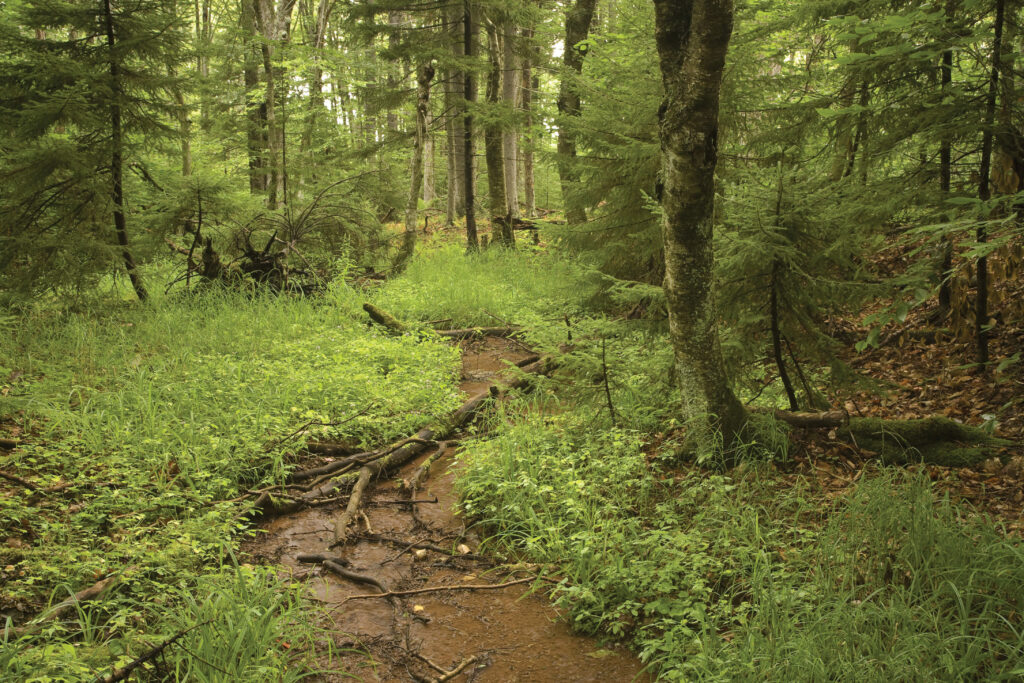
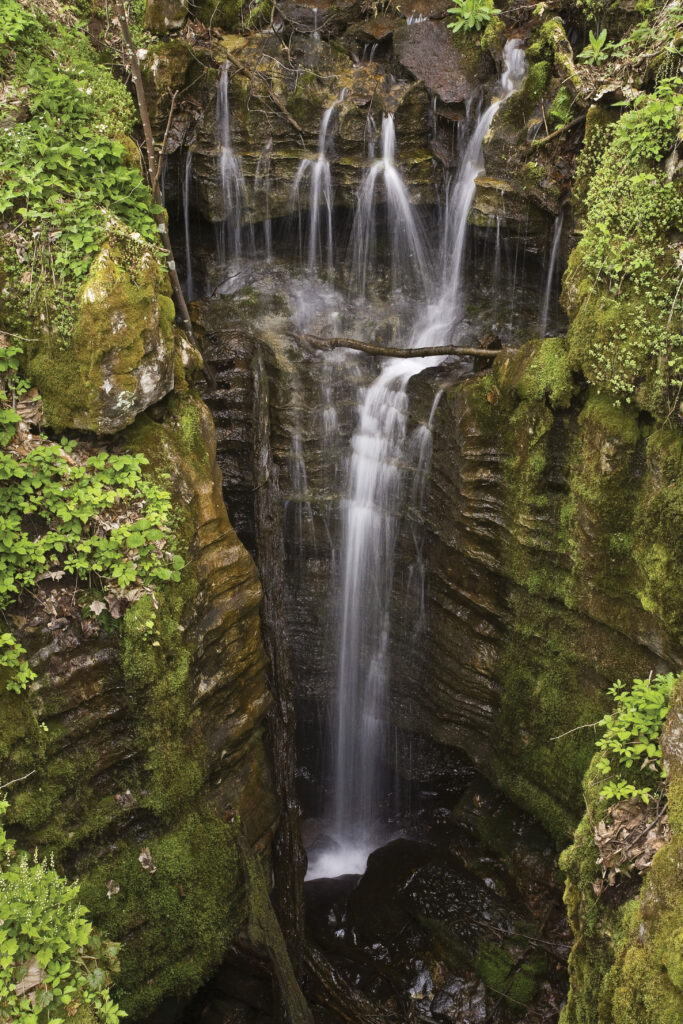
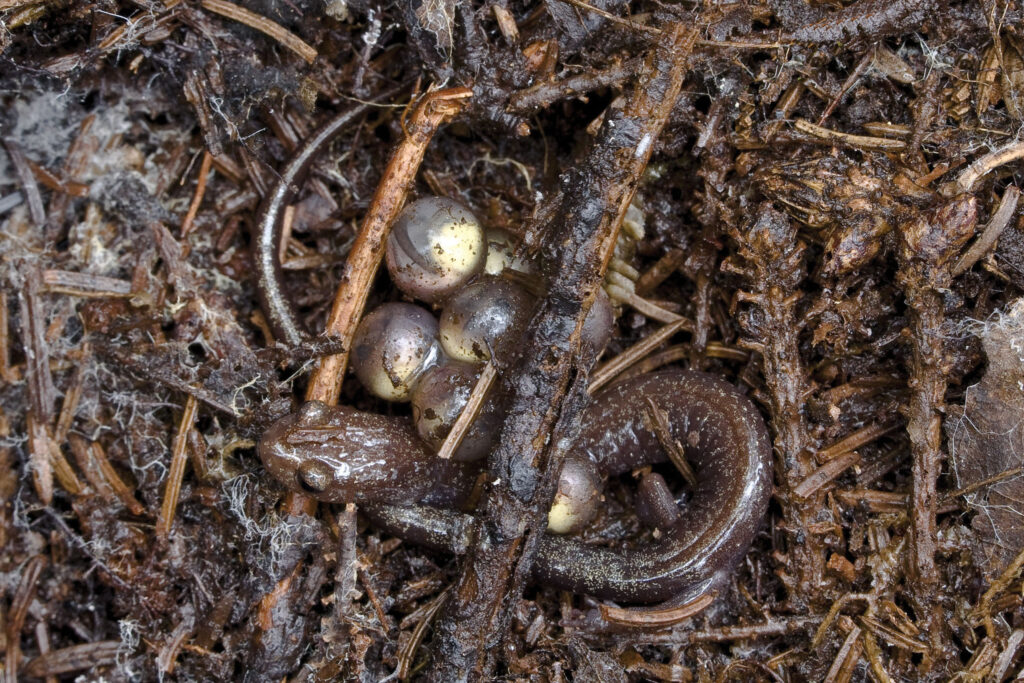
So why is it so important to conserve this peak that’s been here for eons? It’s a spectacular and, at times, brutal locale. Fierce winds flag the trees, stripping branches on the windward side. The mountain’s complex ecological setting—its mix of rock types, elevation, and weather patterns—creates microhabitats just a matter of feet apart, enabling a staggering diversity of life. Byrd says you’ll find hundreds of species of interest, including North America’s smallest owl, the saw-whet; the snowshoe hare; and what she endearingly refers to as “a really beautiful pink-edged sulphur butterfly.”
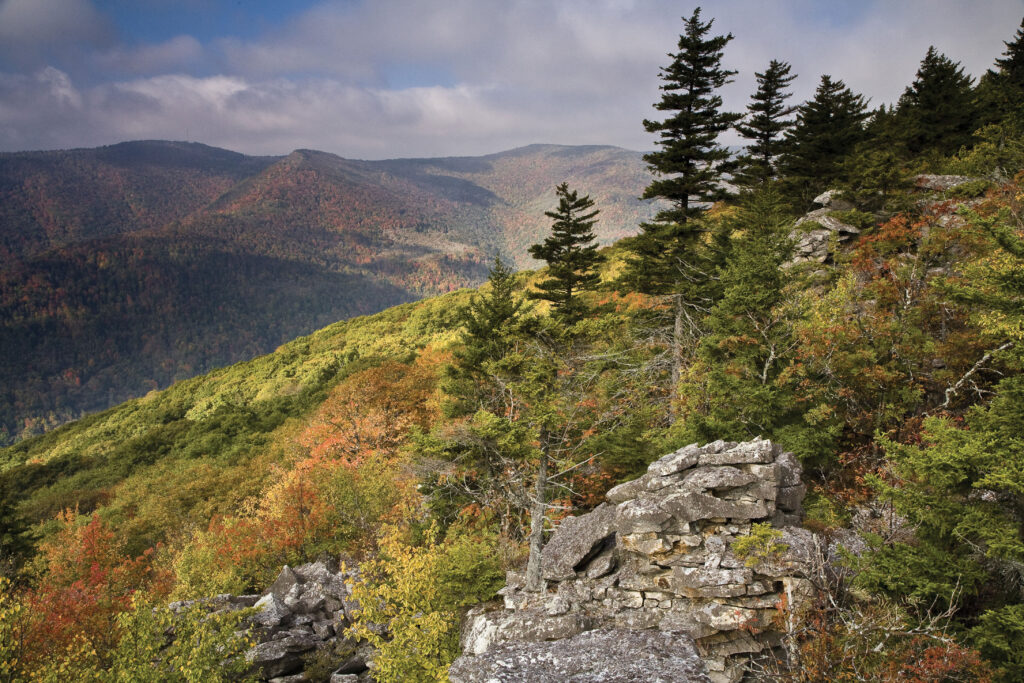
“Mount Porte Crayon,” Byrd adds, “features plant species typically found much further north. In some ways, it’s a snapshot of Canada right here in West Virginia. All of this supports a variety of species you will not find in the surrounding forests.”
Mount Porte Crayon is a striking blend of rugged beauty, a glimpse of Canada tucked into West Virginia, and a fitting tribute to one of our greatest artists, who faced a brush with death near this site nearly 175 years ago. Strother never could have imagined that one day, one of those awe-striking peaks he skirted on the adventure of a lifetime would bear his name—or at least his French pseudonym.
To learn more about Mount Porte Crayon and how to get involved in conservation efforts, visit The Nature Conservancy website at www.nature.org/en-us/get-involved/how-to-help/places-we-protect/mount-porte-crayon-preserve/.
 By
By