 By
By 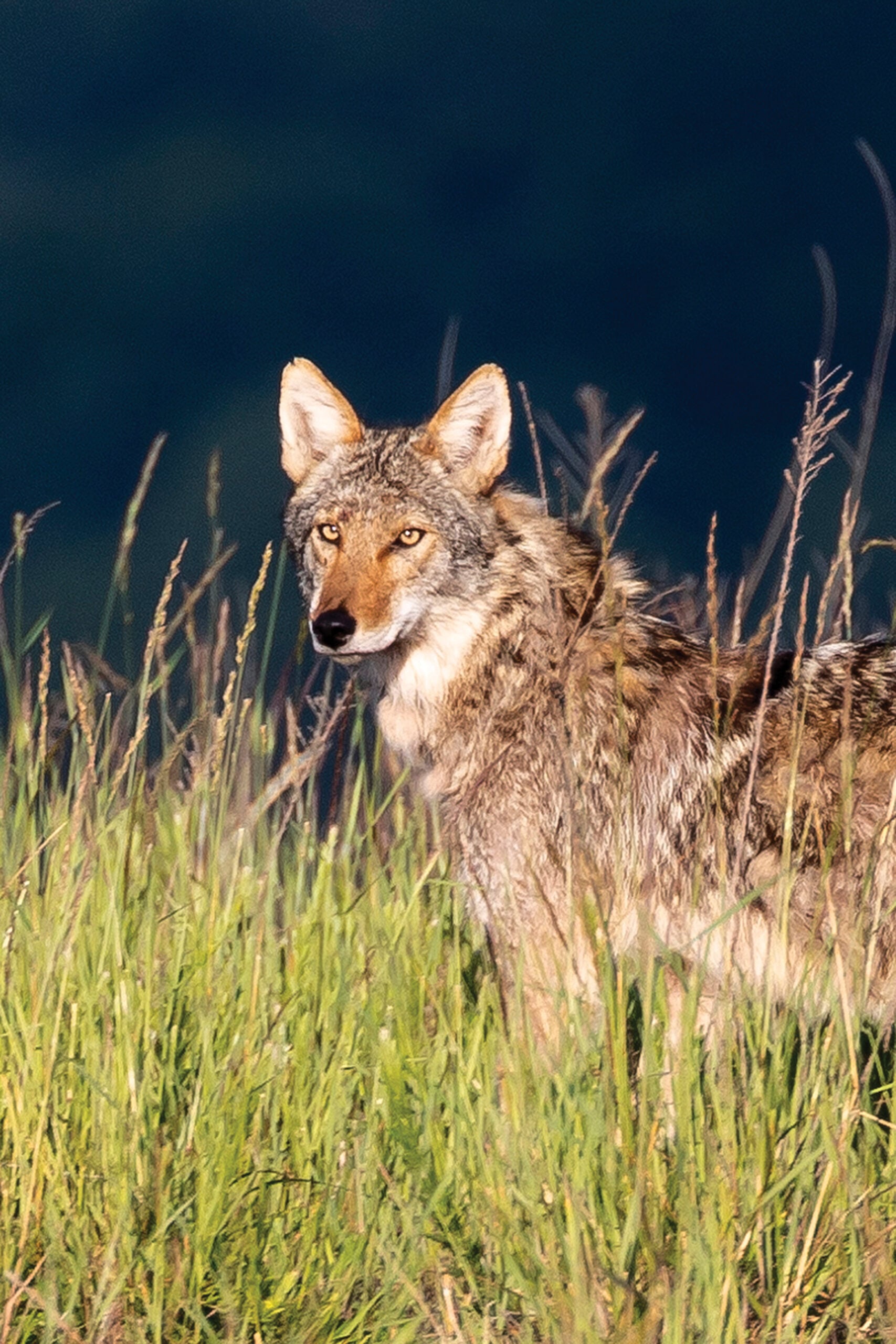
Are coyotes in West Virginia getting a bad rap? This author thinks so.
This story was originally published in the February/March 2026 issue of Wonderful West Virginia. To subscribe, visit wonderfulwv.com.
Written by Laura Jackson
Editor’s Note: This essay is adapted from longtime Wonderful West Virginia contributor Laura Jackson’s debut book, Deep & Wild: On Mountains, Opossums & Finding Your Way in West Virginia. Opinions represented in this article do not necessarily reflect those of the West Virginia Division of Natural Resources.
Western writers love the coyote and his literary lore. He’s woven into the narratives of the western indigenous peoples. Coyote Man is a wise old trickster bounding over the desert slickrock, wrapped in metaphor and symbolism.
But here in West Virginia, our coyotes aren’t slight, wily creatures. They’re more likely to bound into the backyard and snatch an urban chicken.
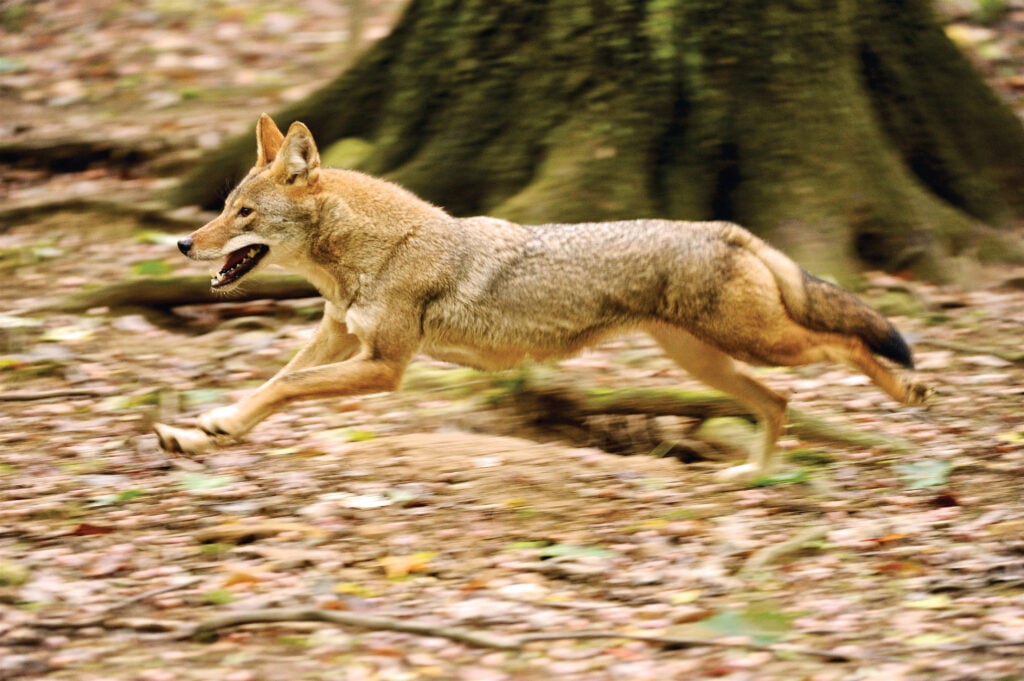
The coyote’s eastern journey began when the western coyote moved up through Canada and down into Appalachia. The timber wolves that once inhabited our region were extirpated in the 1800s—wolves and mountain lions were shot by the thousands, leaving an opening for a larger carnivore. When the western coyote arrived, it bred with the remaining red wolves in the south, timber wolves in the north. The result was a new cover of an old song: the eastern coyote.

The eastern coyote is larger than its western cousin. They’re adaptable, trotting through Manhattan neighborhoods at night and occasionally in broad daylight. A western desert writer would say Coyote Man is bold and sure-footed, a trickster rarely seen and never captured. But here in the east, they’re just scarfing around in the trash.
That’s not to say that eastern coyotes are only dumpster divers. Coyotes eat what they can get, whether it crawls, swims, flies, or rots in a Hefty bag. No wonder nobody has written anything lyrical about them. The coyote on trash night, pawing through an empty lo mein carton, doesn’t shine quite as mystically as Coyote on a butte, howling out his ancestral song at the crescent moon. It’s hard to elevate a creature to the revered status of Coyote Man when your coyotes aren’t revered.
West Virginians revere deer. In the 2024–25 seasons, West Virginia hunters bagged more than 110,000 whitetails. Our reverence for them sustains us in lean times, brings generations together. Hunters contribute to conservation efforts. And though we rage when deer nip our tuberous begonias, they remain a tradition, a living hearth and home around which we gather.
The West Virginia Division of Natural Resources’ efforts to sustain the deer population culminated in the 1990s, when numbers peaked. Since then, whitetails have undergone a population correction, with the division’s steady hand on the wheel. Hunters provide the WVDNR with reports from the field. But this is where things start to go off the rails, because blaming the eastern coyote for a poor deer harvest and shrinking numbers is also tradition, as is the paranoia that rises whenever a coyote is seen.
The whole neighborhood panics. They’re coming for your kids! Someone posts on Facebook that there’s a pack of 20 snatching toddlers out of their sandboxes. Unconfirmed advisories warn that snarling death is on the prowl and to lock up dogs, cats, chickens, and petite mothers-in-law.
It all seemed unnecessarily dramatic to me, and I watched this repetitive discourse for years until one day I decided to find and write the truth. In April 2019, I called Rich Rogers, who was then the WVDNR’s furbearer biologist.
“People think coyotes are killing all the deer,” Rogers told me. “That’s not true. Deer densities have been declining now for years, mainly due to high antlerless harvests, which is what we wanted—to get these deer densities down close to the carrying capacity. They were way over.” He also said deer rely on brush and young trees for food, and with less timber cutting, these areas aren’t as ubiquitous.
Coyotes do prey upon fawns, as do bears and bobcats. However, a recent Pennsylvania study looked at fawn mortality, and while fawns die from predation (black bears kill more than coyotes), it doesn’t reduce the deer population. To confirm, biologists repeated the study and got the same results. The University of Delaware conducted a separate study on fawn mortality in 2018. Coyotes, bears, and bobcats do not exist in Delaware, but that state’s rate of fawn deaths was the same as West Virginia’s.
“Everything kills fawns,” Rogers said. Starvation is very common. He’d even seen a mink kill a fawn.
The coyote’s reputation as a killer was not helped by a PBS documentary called Meet the Coywolf.
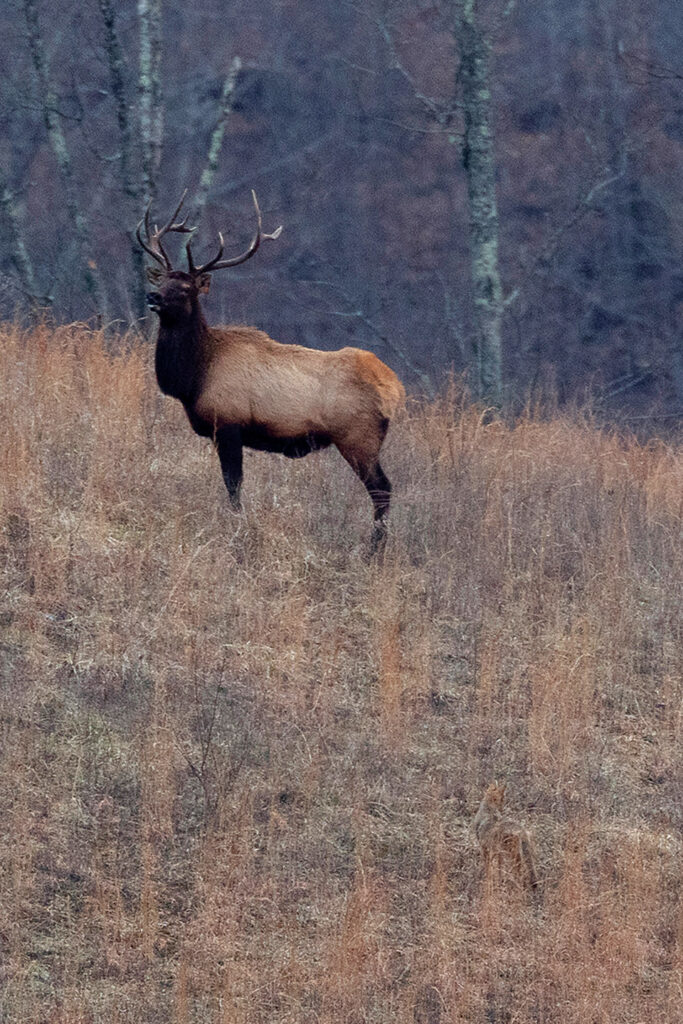
“That was pure, unadulterated garbage,” Rogers growled. “And that caused such a stir, with people thinking, ‘We’ve got this elite predator on the loose!’ That’s absolutely not true. Coyotes aren’t elite predators.”
He said there aren’t as many coyotes in West Virginia as we think. The intensity of the nightly coyote chorus makes that hard to believe, but Rogers said those yips and screams come from only four or five animals. Coyotes don’t live in packs; it’s two monogamous parents and their young, half of which won’t survive. Most never make it to age four.
He’d also heard the rumor that the WVDNR introduced coyotes to control the deer population. “No state has ever introduced coyotes,” he said. “Over the past 34 years, I’ve had many people tell me they have proof, and I’ve yet to be provided with any.”
Once I’d spoken to Rogers, I wrote an article for the Wheeling-based online magazine Weelunk, and with hopeful naivete firmly intact, I waited for people to read the truth about coyotes and welcome science into their hearts.
I couldn’t have gotten a chillier reception if I’d shown up at Thanksgiving with a PETA shirt and a gelatinous tofurkey. The comments online were, in hindsight, perfectly predictable.
They will trick your pets away from the house and eat them.
They can scale eight-foot fences. Grab your pet and go.
I have heard stories they will take the dog’s squeaky toy and run off to the edge of the woods, squeak it and lure your dog out where other coyote are waiting.
Stories. Someone has always heard a story, from his brother, from his brother-in-law, from his brother-in-law’s friend Skeeter who has three DUI’s and is doing community service for stealing a ferret but is definitely credible. And while you might wonder why the coyote would bother with the toy when it could just snatch the little dog right there in the yard, it’s best not to bring that up on a West Virginia Facebook page. (Normally I take “hippie tree hugger” as a compliment, but not when it’s paired with the word “crackpot.”)
The comments proved what Rogers told me—people had already made up their minds. It’s called confirmation bias. Those who believe in a certain answer or outcome will look for evidence to support it, even when presented with conflicting facts. When we note the declining deer population (or a missing cat) and then hear coyotes in the area, we automatically connect the two. But correlation does not equal causation.
Coyotes are opportunists, first and foremost. They hunt rodents but might indeed grab a cat if they can. In 2007, a coyote walked into a downtown Chicago Quiznos and made himself at home in the freezer. Chicago has a notable urban coyote population, and while the animals lie low and avoid people, they’re increasingly drawn to easy meals and garbage. That’s when they encounter humans, and those interactions rarely end well. They’re understandably defensive of their young and will attack a free-roaming dog to protect their pups—as they would for any other perceived potential predator.
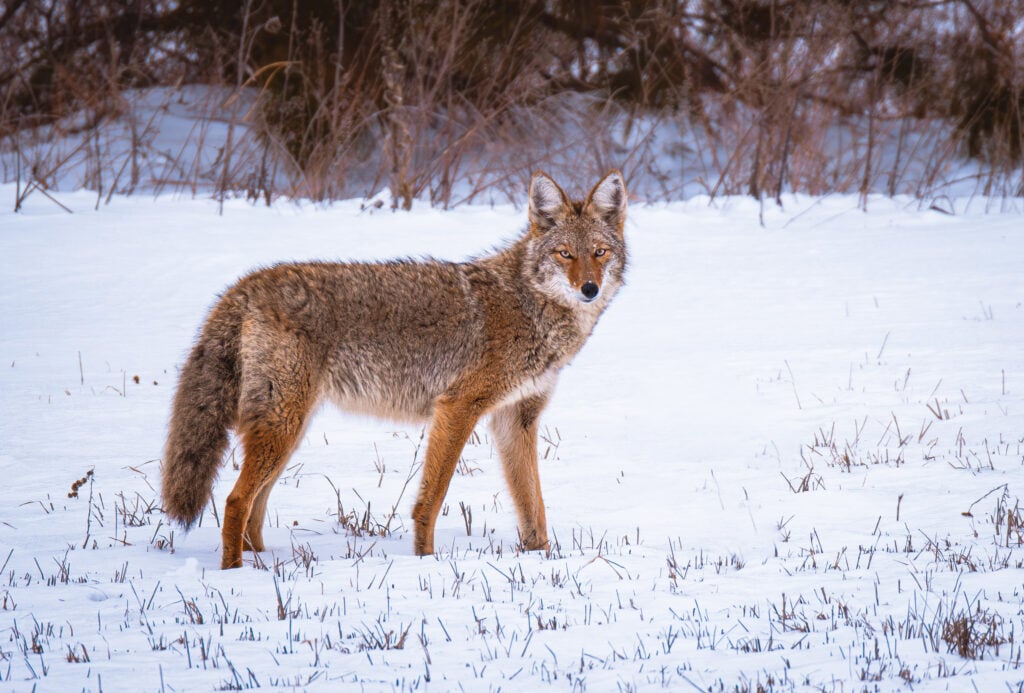
“The survivors from the previous year’s litter take off looking for home ranges, and that’s what causes problems—transient animals,” Rogers told me. “It’s like kicking a bunch of sixteen- and seventeen-year-olds out of the house. They get in trouble.”
Encounters are usually attributable to our habits: we’ve left pet food out and offered them regular meals. Or we’ve encroached on their territory, developed land where a family lives, and pushed the animals out of their home range. Rogers didn’t deny attacks have happened, though they’re incredibly rare—more people are killed each year by errant golf balls and champagne corks than coyotes.
Nevertheless, my article’s comment section grew rough and rowdy. Had I been there in person, I would’ve been targeted with rotting vegetable matter for my blasphemy. I learned, as Rich Rogers warned me, that minds don’t change easily. Sadly, he died in 2022 after 37 years with the DNR. I’d have other interviews with him before his passing, and he was a warm source of knowledge and a consummate West Virginia outdoorsman. I wish he was still out there because, as the minor flap about my article died down, I felt I’d lost the battle.
And so, while the western coyote wanders the desert along the line between ecology and folklore, the eastern coyote remains a varmint. He’s too skulking to be majestic, too adaptable to be anything but a toddler-terrorizing, chihuahua-snatching villain. What might look like wisdom in the sure-footed canine as he slips through a dusty arroyo looks more like a plot to scarf a bowl of Fancy Feast when he’s creeping along Greenwood Avenue. No writer has seized upon the eastern coyote with reverence. Nobody is following a lyrical trickster’s trail of mischief through Wheeling, West Virginia.
Odds are good, though, that he’s following ours.
Bookmark It!
Pick up a copy of Deep & Wild: On Mountains, Opossums & Finding Your Way in West Virginia at your local bookseller or on Amazon.

 By
By