 By
By 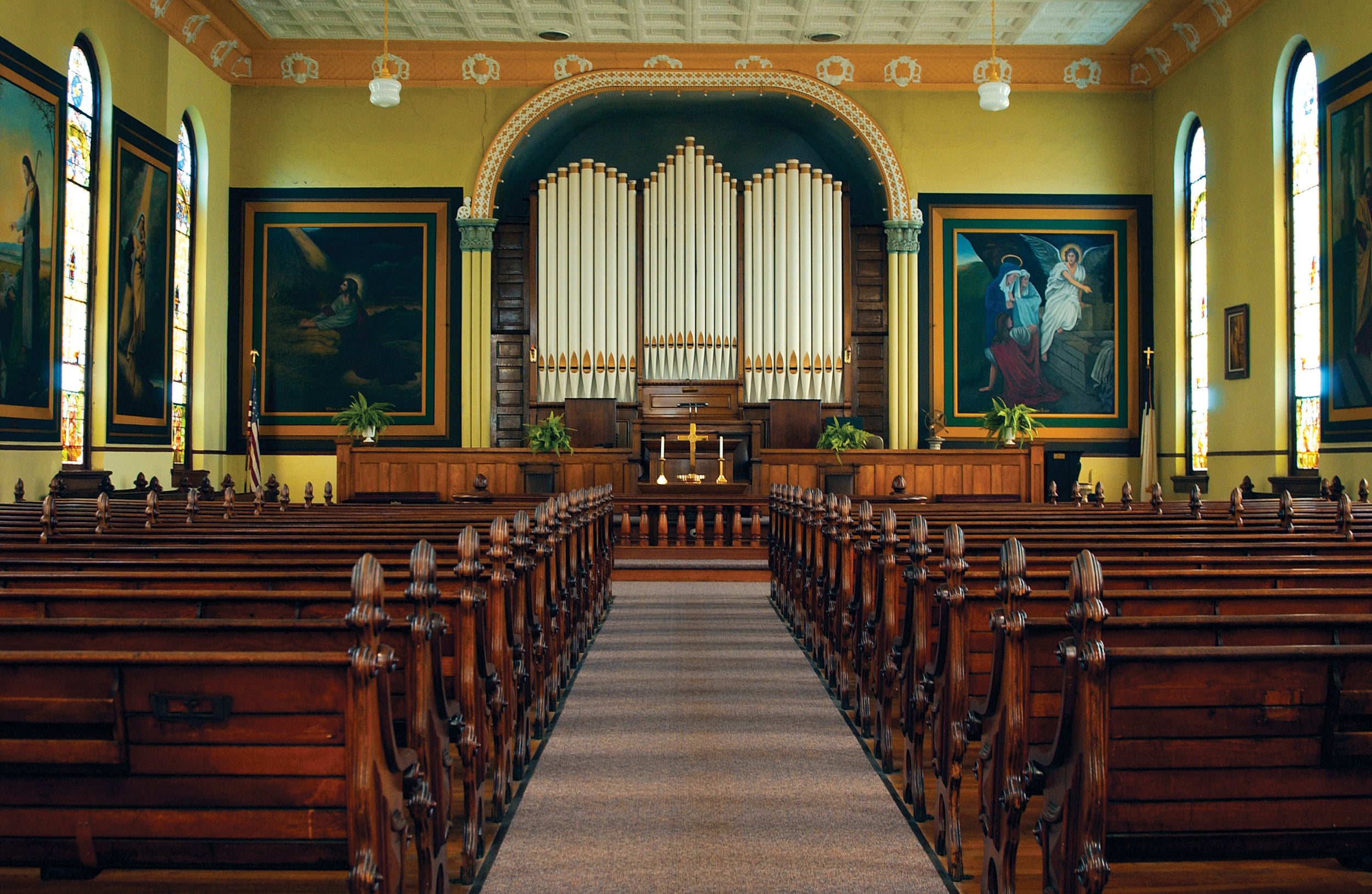
The true story of May’s most popular holiday.
This story was originally published in the April/May 2026 issue of Wonderful West Virginia.
Subscribe here.
Written by Stan Bumgardner
At 10 a.m. on a quiet Sunday in 1908, Grafton’s Andrews Methodist Episcopal Church became the birthplace of a holiday that would soon circle the globe. That day fulfilled the dream of Anna Jarvis, who had set out to honor her mother, Ann Reeves Jarvis, three years after her death on the second Sunday in May 1905.
As the holiday she created evolved, however, her dream would turn into a personal nightmare.
Ann Reeves Jarvis often said that, amid the unending demands of motherhood, every mother should have one day a year to rest. Those thoughts came rushing back to her daughter as she laid her mother to rest, remembering that she “went directly from the grave to my room and began to plan for Mother’s Day.” According to Katharine Lane Antolini, author of Memorializing Motherhood: Anna Jarvis and the Struggle for the Control of Mother’s Day (WVU Press), Jarvis launched an ambitious letter-writing campaign to promote her cause, reaching out to political, religious, and business leaders, including prominent Americans such as Mark Twain and President Theodore Roosevelt.
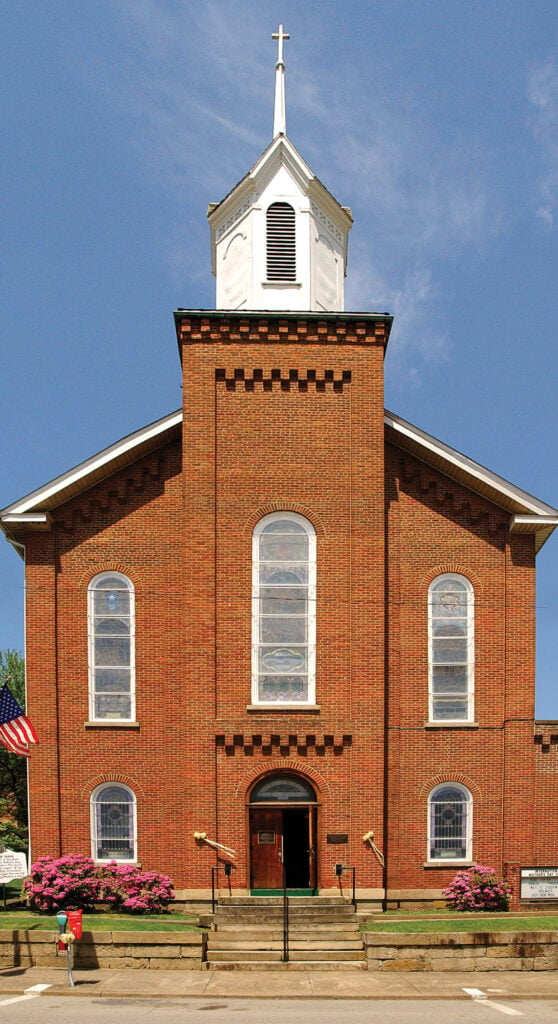
On May 10, 1908, more than 400 attended the nation’s first Mother’s Day service at Andrews Methodist, while another service, attended by Anna, was held that afternoon in her adopted hometown of Philadelphia. The Grafton setting was a fitting site for the first ceremony. Ann Reeves Jarvis had helped form the church in the 1870s and taught Sunday school there for two decades, often highlighting the significant, if under-recognized, roles played by women in the Bible.
Ann Reeves Jarvis
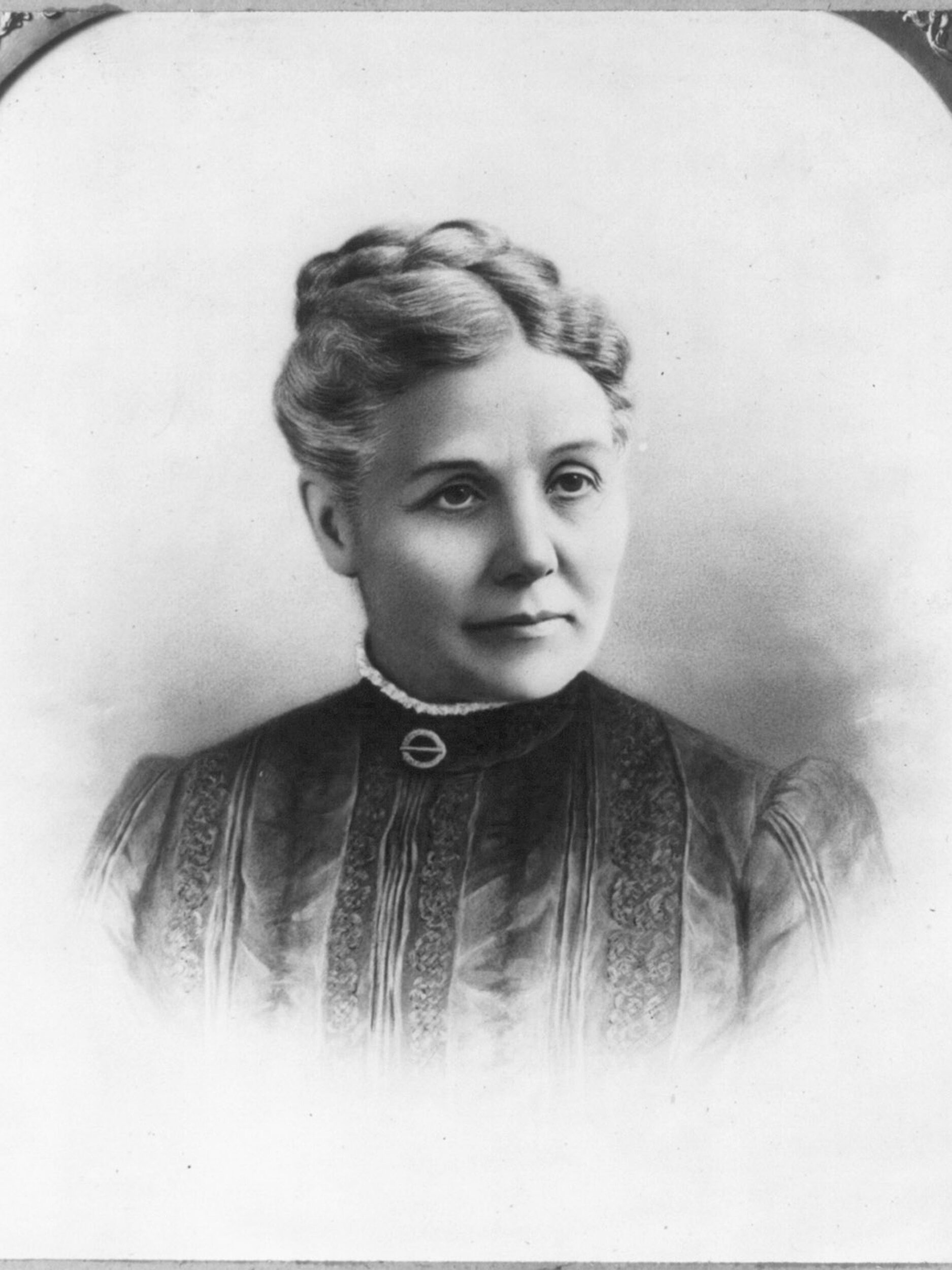
She was born in Culpeper County, Virginia, and in 1832, moved with her family to Philippi when she was 13. Seven years later, she married Granville E. Jarvis, a merchant who would later prosper in real estate, coal, and timber. The couple soon settled in the Taylor County village of Webster. According to census records, she gave birth to 11 children, but only four survived to adulthood—a tragic reality of the era.
Soft-spoken yet strong in spirit, Jarvis channeled her profound loss into public service. She worked to improve the unsanitary living conditions in her area. She raised funds for medicine, nursed sick neighbors suffering from tuberculosis, and advocated for clean water and safer sewage disposal.
When the Civil War deeply divided Taylor County between North and South, Jarvis brought women together to form Mothers’ Day Work Clubs and insisted they remain neutral. Members cared equally for Union and Confederate soldiers, and she opened her home to the sick and wounded from both sides.
After the war, she organized a Mothers’ Friendship Day in Pruntytown, then the county seat, drawing some 5,000 veterans from the opposing armies. The gathering was widely credited with easing lingering hostilities in the region. Olive Ricketts, executive director of the Anna Jarvis Birthplace Museum in Webster, says the Mothers’ Friendship Day was a pivotal moment that subdued what likely would have been years of friction.
“Ann wore gray even though she was blue,” Ricketts says. “Her friend wore blue even though she was gray. They played ‘The Star-Spangled Banner’ first for the North and then ‘Dixie’ for the South. Then they played ‘Auld Lang Syne.’ By the time the band got to the words ‘Should auld acquaintance be forgot,’ all 5,000 men had laid down their weapons and made up with their neighbors. Ann said, ‘There’s no reason for us to fight a war that’s over.’”
Jarvis’ courage was so striking that a minister documented the event in a church Bible and expressed fear that she would be shot for her stance. She was intrepid, though, in everything she did. Ricketts notes, “She did things like this over and over throughout her life. If I was going to be like anybody in the world, I would be like her. She could get people to do the right thing.”
Anna Jarvis and the Holiday She Created
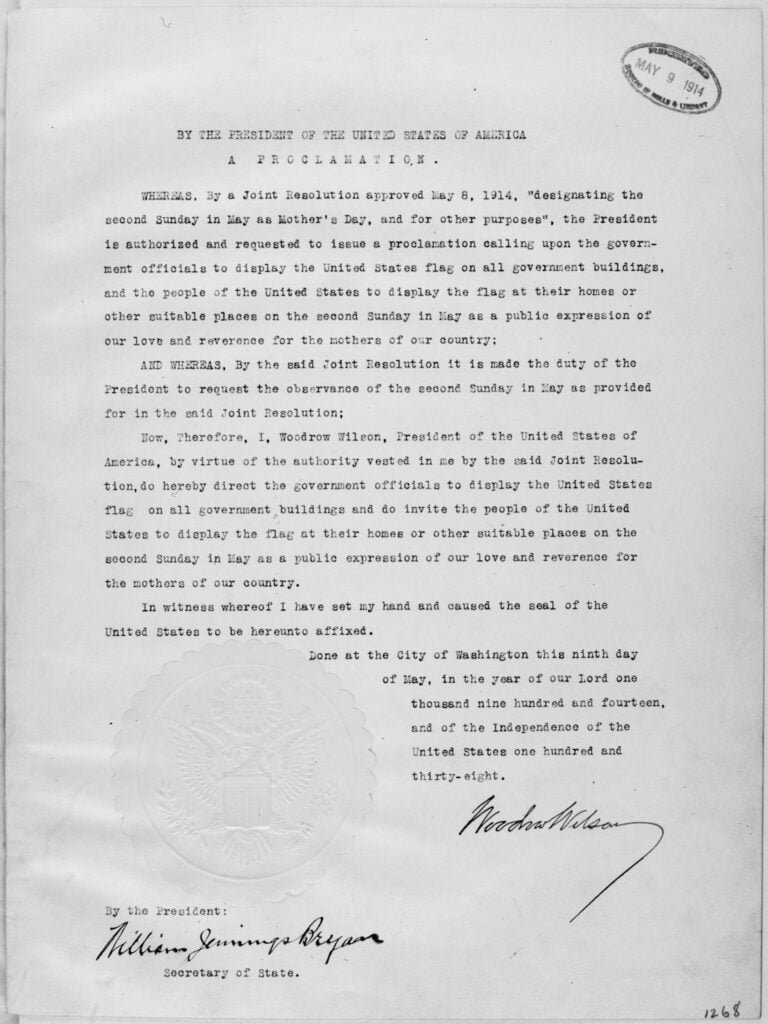
Inspired by her mother’s life, Anna Jarvis turned that first church service into a movement. By 1911, Mother’s Day was celebrated in all of the nation’s 48 states and on four continents. She appealed to President Woodrow Wilson, who she had first met while attending college in Staunton, Virginia. On May 9, 1914, Wilson officially proclaimed the second Sunday in May as Mother’s Day in the United States.
For the younger Jarvis, the holiday was extremely personal. She fiercely guarded what she considered to be its true purpose. Through the Mother’s Day International Association, incorporated in 1912, she attempted to copyright and trademark “Mother’s Day” and “second Sunday in May,” issuing stern warnings against any misuse of the holiday.
Ricketts sums up Jarvis’ idea of Mother’s Day: “It wasn’t for us to buy our mother a gift or take her out to dinner. All Anna wanted was, for one day a year, a mother should be able to sit on the back porch with a cup of coffee and not be disturbed.”
But Jarvis grew concerned as the holiday turned into a collective tribute to all mothers. She insisted the apostrophe in “Mother’s” be singular, emphasizing that the day should honor one’s own mother, and encouraged children to visit their mothers in person.
And the holiday quickly became commercialized, generating a windfall for greeting card companies, candymakers, and florists. Jarvis denounced them as “profiteers,” worrying that cards and gifts would replace the personal connection she had intended. Ricketts says that Jarvis became especially resentful of the men who ran the companies for their get-rich-quick attitudes toward Mother’s Day. As Antolini notes, Jarvis even criticized advocates of similar holidays, including Father’s Day, calling them “anti-mother propagandists.”
Though Anna inherited substantial wealth from her father and later from her brother Claude, she lived frugally and became increasingly isolated in her Philadelphia home. In one rare public appearance, she spoke to a large crowd at the dedication of the West Virginia State Capitol on June 20, 1932. She was the only woman on the program.
By this time, Ricketts says Jarvis had become virtually “obsessed” with restoring the true meaning of Mother’s Day. In the 1930s, Jarvis was a combative thorn in the side of those wanting to take advantage of the holiday in any way, even for principled purposes such as fundraising for poor women and children during the Great Depression. Raising money in the name of Mother’s Day was as far from her original intent as possible. She accused charities of leveraging Mother’s Day to line their own pockets, denouncing them as “charity charlatans” and “Christian pirates.” She directed some of her ire at Congress, which in 1933 passed a resolution urging people to give money to churches, welfare agencies, and other organizations that provided relief to destitute women and children.
In particular, she locked horns with the Maternity Center Association (MCA), headquartered in New York City. It supported pre- and post-natal care to address high mortality rates among expectant mothers and babies. One of the MCA’s main initiatives was an annual Mother’s Day–centered fundraising campaign. It was backed by prominent women such as First Lady Eleanor Roosevelt and U.S. Secretary of Labor Frances Perkins. Jarvis considered these women wealthy enough to support their own causes without involving Mother’s Day. She wrote scathing letters to the husbands of women involved with the MCA. Even President Franklin D. Roosevelt found himself on the receiving end of her blunt communications. Jarvis saw all these groups and individuals as threats to the real purpose of the holiday. After 1933, she withdrew from public Mother’s Day ceremonies, describing herself as “just an observer of the fakers.”
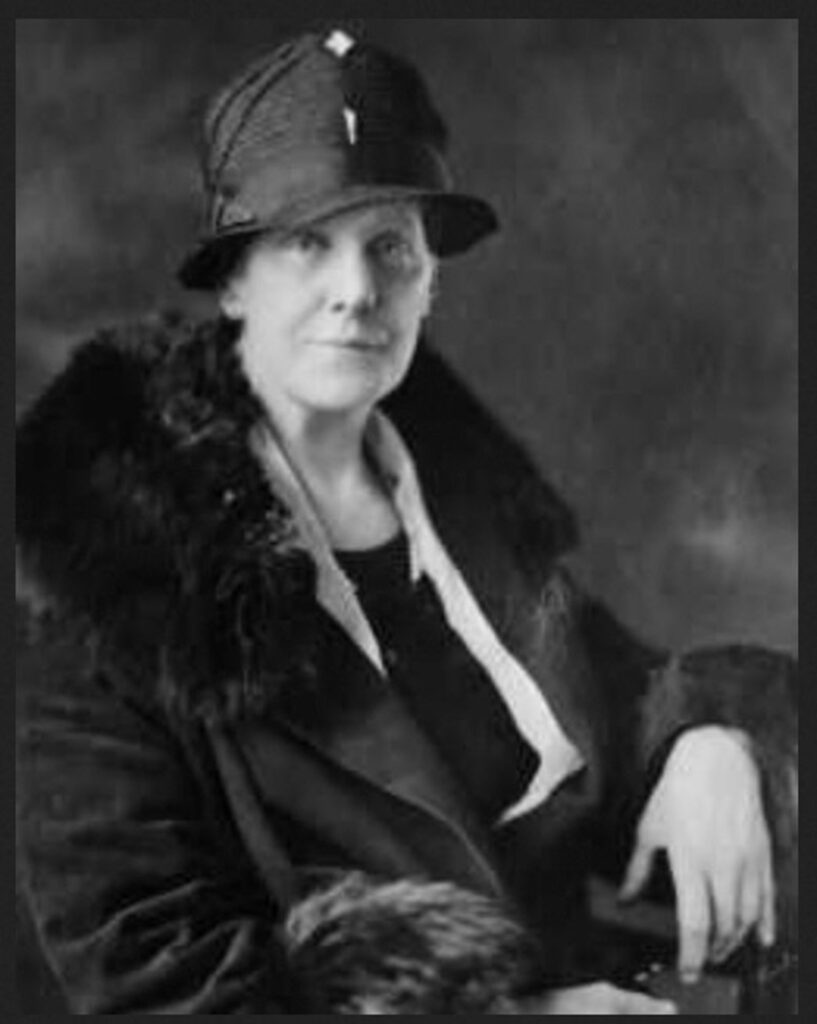
Once celebrated as a visionary, Jarvis gradually became known for her relentless scolding. The press reported on her declining mental health and finances. A 1938 article in Time claimed that her three-decade-long campaign had “crushed her in body and soul.”
Anna Jarvis never married or became a mother herself. She outlived all her family except one niece and died in Philadelphia’s Marshall Square Sanitarium on November 24, 1948. She is buried in Bala Cynwyd, Pennsylvania, in West Laurel Hill Cemetery, in a lot with her mother, brother Claude, and sister Elsinore.
Mothers make the world go ’round—and thanks to Jarvis, families around the world set aside a day each year to acknowledge that. We may all do well to take Jarvis’ concerns to heart as we honor our own mothers this year: Greeting cards and grocery store bouquets are nice, but a day of true relaxation is a love language all mothers appreciate.
Mother’s Day Sites in West Virginia
Anna Jarvis Birthplace Museum | Webster
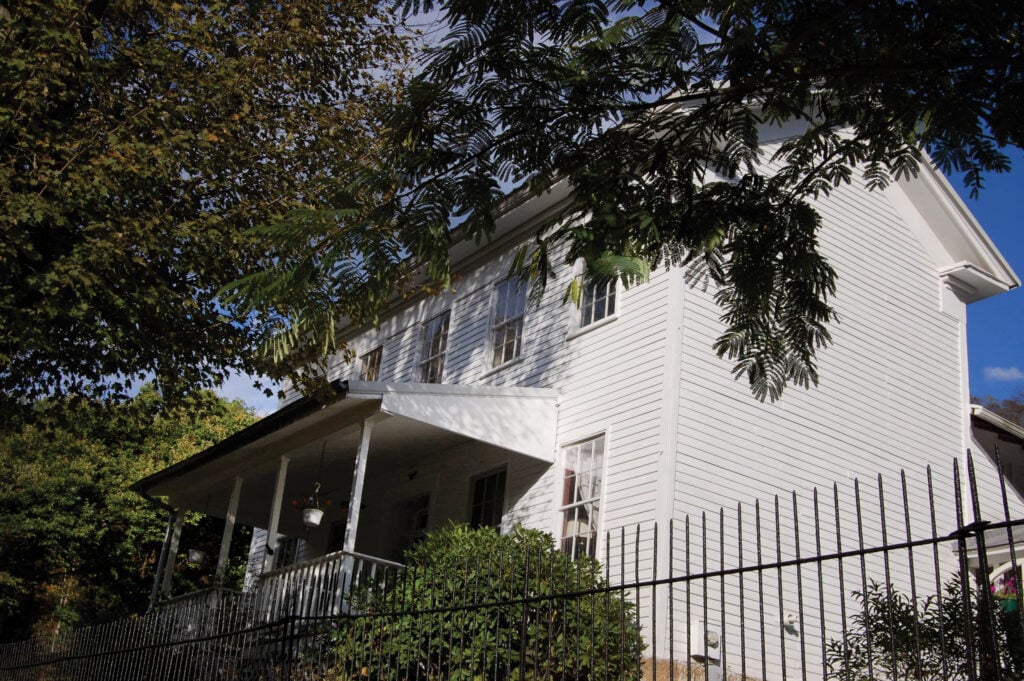
Olive Ricketts and her late husband, Thomas Dadisman, opened the Anna Jarvis Birthplace Museum in 1996. They restored the old house, which served as Union General George B. McClellan’s headquarters during his 1861 opening Civil War campaign. The museum houses more than 5,000 artifacts related to the Jarvis family and Mother’s Day, including dresses that belonged to Anna Jarvis. Open Tuesday through Saturday, April 1–December 31. A large parking lot is convenient for school and tour buses. Visit www.visitmountaineercountry.com/anna-jarvis-birthplace-museum, follow the museum’s Facebook page, or call 304.265.5549 for more information.
International Mother’s Day Shrine | Grafton
Andrews Methodist Episcopal Church, dedicated in 1873 and the site of the first Mother’s Day ceremony in 1908, is now known as the International Mother’s Day Shrine. It is open Thursdays through Saturdays in addition to a service and open house on Mother’s Day. It is one of West Virginia’s 17 National Historic Landmarks, as designated by the U.S. Secretary of the Interior. Visit www.internationalmothersdayshrine.org or call 304.265.1589 to learn more.

 By
By 
 By
By