 By
By 
That tiny bug crawling past your shoe may be a vital part of an ongoing study at the WVDNR.
This story was originally published in the July 2025 issue of Wonderful West Virginia. To subscribe, visit wonderfulwv.com.
Written by Mason Jack
Photos Courtesy of Jakob Goldner
On a hot, clear day along one of West Virginia’s mountain streams or rivers, you might not notice anything unusual happening on the sandy, gravelly banks. But if you look closely, you could catch a flash of movement between patches of sand. It might look like just another bug, but that quick-footed little creature is a predator, a survivor, and the reason a team of conservation biologists is carefully working the shoreline with paint pens and Solo cups in hand.
Meet the Appalachian tiger beetle, Cicindela ancocisconensis, a half-inch-long powerhouse of a bug whose presence is both a marker of ecological health and the focus of a significant new effort by the West Virginia Division of Natural Resources (WVDNR). Right now, in one of the most focused and methodical insect studies the agency has undertaken recently, the Wildlife Diversity Unit is conducting a mark–recapture population study to answer one deceptively simple question: How many of these beetles are left?

“My job is to know which insects West Virginia has and, ideally, how many,” says WVDNR Conservation Entomologist Jakob Goldner. “Obviously, that’s a tall order. But the Appalachian tiger beetle is one we already knew a bit about, and we had a sense its population was contracting. That made it a great place to start.”
A Beetle Built for the Mountains
As a group, tiger beetles are known for their exceptional speed, their sharp jaws, and, for some, metallic beauty. The Appalachian tiger beetle is subtler in appearance. “They’re not as flashy as some others,” Goldner explains. “They’re more of a dull brown color with some faint markings, but they have these beautiful iridescent green legs and undersides that shimmer when you catch them in the light.”
While small in size, these beetles are formidable hunters. They’re visual predators, relying on their excellent eyesight and lightning-quick reflexes to chase down ants, flies, and other small invertebrates along riverbanks. Goldner describes them as “aggressive for their size,” pointing out that their “tiger” name comes from the blade-like mandibles they use to seize prey. “They eat anything they can overpower,” he says, “and that’s impressive when you’re talking about a beetle the size of your thumbnail.”
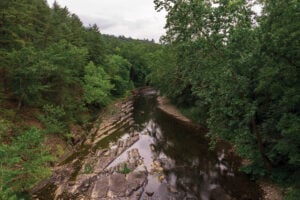
This species is special in another way: It’s one of the few tiger beetles that live at high elevations throughout the Appalachian Mountains. Its habitat is surprisingly specific. “They’re not aquatic, but they live along streambanks,” Goldner says. “They like sandy or gravelly patches with very sparse vegetation. They need a certain kind of disturbance, like flooding or ice events that scour off the plant cover and expose fresh ground.”

Until now, most tiger beetle work in the state was what Kieran O’Malley, WVDNR Wildlife Diversity Unit coordinator, calls “presence–absence” methods. In other words, biologists would confirm whether beetles existed at a site but not how many. That changes with the current project.
“We’re now using mark–recapture to estimate population size, which gives us a more complete picture than the presence–absence surveys we’ve relied on in the past,” O’Malley says. “This is our chance to establish a population baseline that we can return to in the years ahead.” He continues, “We’ve had records of where they occurred, but this is our baseline. We want to know how many individuals occupy a patch of habitat today so we can come back in five or 10 years and see what’s changed.”
The method is classic wildlife biology. Beetles are captured, marked with unique alphanumeric codes using paint pens, released, and then recaptured a day or two later. By comparing how many marked beetles appear again, biologists can estimate how many are out there.
“They stick pretty tightly to a strip of exposed riverbank,” Goldner notes. “That makes the surveys easier. It’s not like a turtle that can disappear into the woods.”

The simplicity of the method, though, doesn’t mean the work is easy.
Catching a beetle without harming it takes some creativity. Goldner and his team adapted a method developed in Italy using nothing more than red Solo cups, upside-down Dixie cups, and scrap metal.
“We needed a way to catch them alive. Standard insect traps usually have soapy water to drown the bugs, but that obviously wouldn’t work,” he says. “So we built these V-shaped pitfall traps that hold them just snugly enough to keep them from flying out. We used scrap pieces from our office’s HVAC renovation as fencing to guide them in.”
Even with clever traps, success depends heavily on the weather. Tiger beetles are visual predators and don’t hunt as often on overcast days. “We had one cloudy day where we caught less than 10 beetles. Next day, sunny, we caught more than 50,” Goldner says. “That’s a huge difference, and it means we have to plan our fieldwork around the forecast almost hour by hour.”
Why Now?
The Appalachian tiger beetle isn’t federally listed as endangered, but it is considered vulnerable and has disappeared from parts of its former range, especially in the Northeast. That makes the current study both urgent and proactive.
“West Virginia has been seen as kind of a stronghold,” Goldner says. “We have higher elevations and less urban development than other places. Historically, we had more of the natural disturbance events these beetles rely on, like ice flows and floods. But we don’t know if that’s still true.”
According to O’Malley, this study fits into a long-term effort by the Wildlife Diversity Unit to track species’ health across the state. While the Appalachian tiger beetle isn’t federally listed, understanding its habitat needs and population dynamics could help prevent future declines. “Our goal is to keep common things common,” he says. “By gathering real numbers, we can better understand population stability before any species reaches a point of concern. This approach helps us track change over time and detect early warning signs.”
It also supports interagency collaboration. While the WVDNR typically oversees aquatic invertebrates, O’Malley explained that terrestrial insects like tiger beetles often fall in a jurisdictional gray area, requiring cooperation with the Department of Agriculture to ensure these species don’t slip through the cracks. However, as O’Malley explains, “They are important components of a natural environment, and we want to make sure our natural systems are intact and functioning right.”
Tiny Trackers, Big Buzz

Jakob Goldner is also involved in another remarkable insect project in West Virginia: radio tracking bumble bees. Inspired by bat telemetry, the WVDNR began attaching tiny solar-powered transmitters to common bumble bee species to test tracking methods that might one day help locate the nests of rusty patched bumble bees, a federally endangered species.
“Most of what we know about rusty patched bumble bee nests is accidental,” Goldner says. “Someone finds one in a brush pile or a crack in a wall. We wanted a better way.”
How do you put transmitters on bees? “You chill them in a cooler, shave a little patch of their fur, and attach the tags with super glue,” Goldner explains. “It sounds wild, but it works.”
The transmitters weigh less than a one-twentieth of a Skittle and last far longer, thanks to solar power. Combined with receiver towers and handheld tracking devices, they’ve already offered new insights into bumble bee behavior, like how future queens spend their time.
“One of our test bees spent two days feeding on the same thistle,” Goldner says. “It didn’t help us find a nest, but it matched recent findings that certain bees forage solo before hibernating. That was valuable, too.”
This kind of fine-scale data on bee movement is a big step forward. “We’re still early in the process,” Goldner says, “but this kind of research could help us understand not just where bees live, but how they use the landscape. That’s vital for protecting them long-term.”
Hopefully, these techniques will eventually help scientists locate and protect nesting areas that are critical to bee survival. This project is still in its early stages, but it’s already helping biologists understand bee behavior better and refine methods for future endangered species work.
What the Beetles Tell Us
Tiger beetles aren’t just fascinating—they’re also bellwethers. “They’re considered ecosystem indicators,” Goldner says. “If you have tiger beetles on your riverbank, it probably means the riverbank is doing okay.”
They also serve as a gateway into insect appreciation. While tiger beetles may be small, their striking features and specialized habitats have made them a favorite among nature enthusiasts and an effective way to help the public engage with insect conservation more broadly.
Still, their future depends on how we treat their habitat. Goldner points to invasive species like Japanese knotweed as significant threats. “It heavily shades the river bank. For these beetles, that’s like being taken from a sunny beach and put into a redwood forest.”

Luckily, protecting tiger beetle habitat doesn’t require becoming a field biologist. Goldner says the biggest help is simply respecting riverbanks. “If you’re fishing, leave no trace. Don’t trample sensitive areas where their larvae burrow. Use native plants for bank stabilization and, if you can remove invasive plants, do it. It makes a real difference.”
Insects are crucial components of the food web, he emphasizes, playing roles not just as pollinators but as essential energy sources for other wildlife. Birds, bats, and fish rely on insects for food, making their presence vital to healthy ecosystems.
Whether it’s a tiger beetle racing across a riverbank or a bumble bee hovering near a goldenrod, these insects remind us that small doesn’t mean insignificant. They’re essential to our ecosystems, serving functions as pollinators, predators, and prey.
Thanks to the work of West Virginia’s Wildlife Diversity Unit, they’re finally getting the attention they deserve.

 By
By